

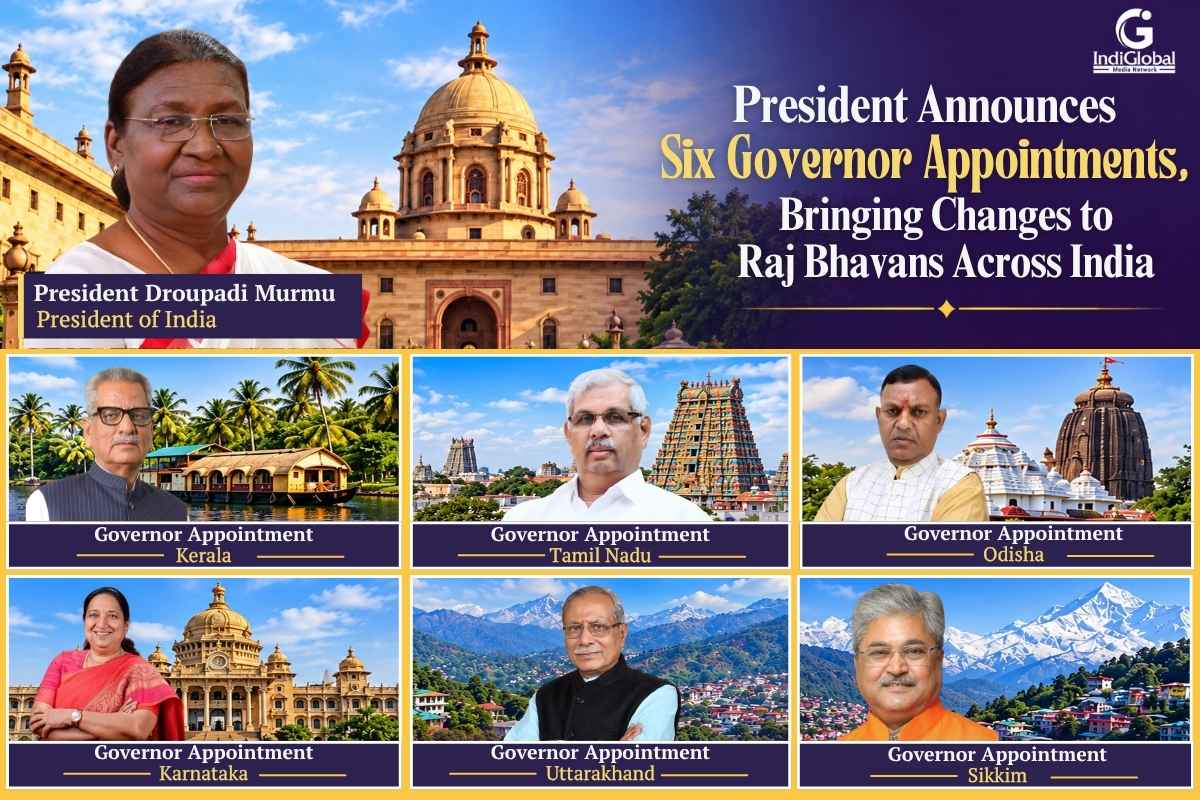
India is set to see changes at six Raj Bhavans following a fresh round of gubernatorial appointments announced in a press communiqué issued by Rashtrapati Bhavan on October 12. The changes include the movement of two serving Governors to new states and four new appointments.
Om Prakash Mathur, currently serving as Governor of Sikkim, has been appointed Governor of Kerala. Rajendra Vishwanath Arlekar, who has been serving as Governor of Kerala, will move to Tamil Nadu. Braj Mohan Ram has been appointed Governor of Odisha, Dr. Sudha Yadav Governor of Karnataka, Dr. Dhal Singh Bisen Governor of Uttarakhand and Dushyant Gautam Governor of Sikkim.
The communiqué makes clear that the appointments will take effect when the respective appointees assume charge. Until then, the announcement should not be confused with the completion of the formal handover in each state.
Why the changes matter
A Governor is the constitutional head of a state, but the everyday business of government is led by the elected Chief Minister and Council of Ministers. The office becomes especially important when legislation is sent for assent, a new government must be formed or a constitutional question calls for careful judgment.
That distinction matters in Kerala and Tamil Nadu, where the relationship between elected governments and Raj Bhavans has been closely scrutinised in recent years. Disagreements over pending bills and university administration have placed the Governor’s constitutional role in the public spotlight. The arrival of Mathur in Kerala and Arlekar in Tamil Nadu will therefore be watched not just as a change of officeholders, but for the tone of institutional relations that follows.
Karnataka and Odisha see new faces
In Karnataka, Dr. Sudha Yadav will take charge of the Governor’s office in a state with a large higher education sector and an influential technology and industrial economy. Governors may have responsibilities in relation to universities under specific state laws, although those powers differ from one state to another.
Braj Mohan Ram’s appointment in Odisha comes as the state continues to navigate questions of industrial growth, tribal welfare, infrastructure and regional development. The Governor also has particular constitutional responsibilities under the Fifth Schedule in states with Scheduled Areas, making the office relevant to important questions of tribal administration.
A transition in the Himalayan states
Uttarakhand and Sikkim bring a different set of challenges, from mountain connectivity and disaster resilience to environmental protection and tourism. Dr. Dhal Singh Bisen has been appointed to Uttarakhand, while Dushyant Gautam will take over in Sikkim following Mathur’s move to Kerala.
These issues remain primarily within the responsibilities of the elected governments. The Governor’s contribution lies in performing constitutional duties, maintaining institutional continuity and working within the boundaries set by law.
The constitutional framework
Under Article 155 of the Constitution, Governors are appointed by the President. Article 156 provides that they hold office during the pleasure of the President, while also referring to a five year term. Article 159 requires a Governor to take an oath before entering office.
In most matters, the Governor acts on the aid and advice of the state Council of Ministers, subject to constitutionally recognised exceptions. The office is not intended to function as a parallel elected government. Its credibility rests on constitutional restraint, fairness and respect for democratic institutions.
What happens next
The next step will be the formal assumption of office in each state. The oath is ordinarily administered by the Chief Justice of the relevant High Court, or by the senior most available judge when the Chief Justice is unavailable.
For the six states, the appointments open a new chapter in their relationship with Raj Bhavan. Beyond the names and transfers, the real test will be how each Governor approaches the responsibilities of the office and builds a constructive working relationship with the elected government while remaining faithful to the Constitution.
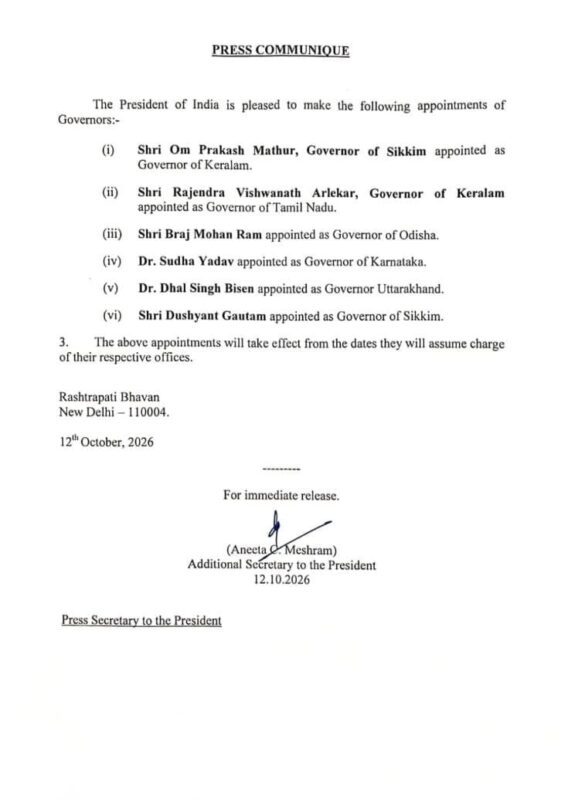 Source: Press communiqué attributed to Rashtrapati Bhavan, dated October 12, 2026, provided for this report.