

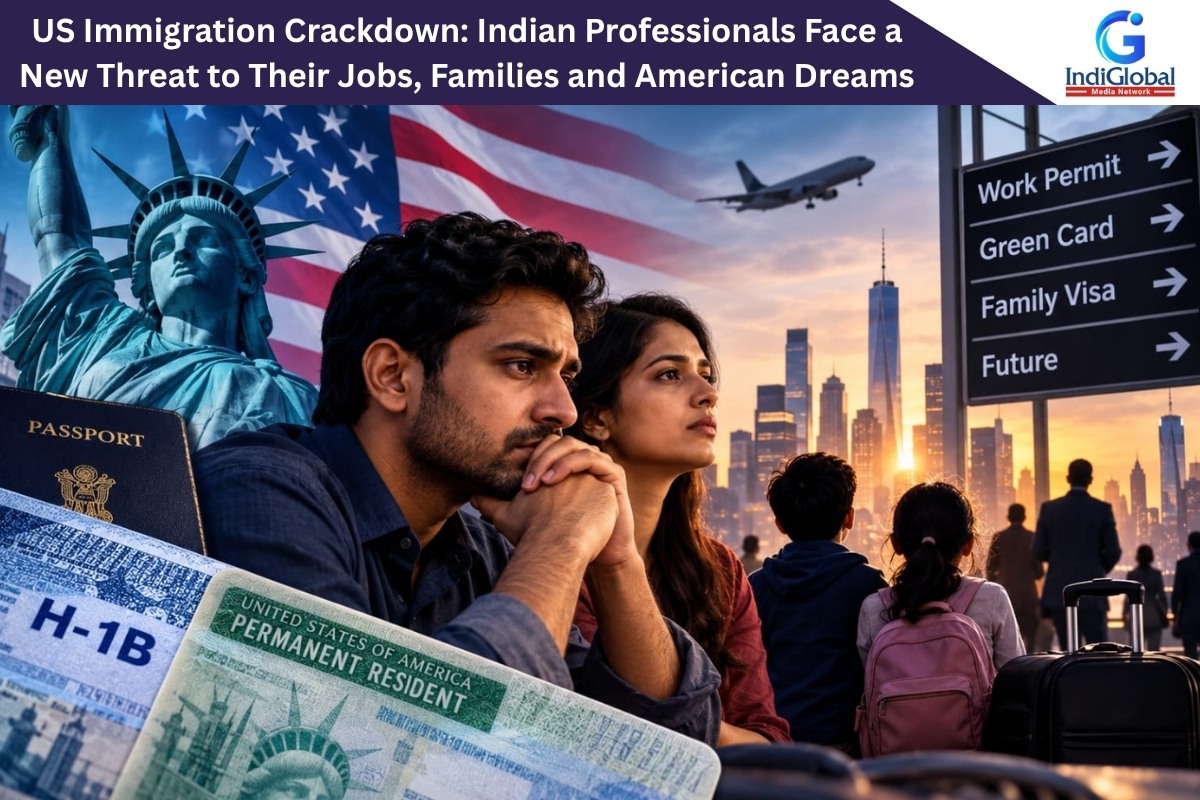
For decades, the United States has represented opportunity for generations of Indian engineers, technology professionals, researchers and their families. Many left behind established careers in India, invested years in American education and built their lives around the promise of professional growth and eventual permanent residency.
The consequences extend well beyond visa paperwork. For some families, a delayed immigration decision could mean losing the right to work, disrupting household income or reconsidering whether to remain in the United States.
Indian Families Caught Between Two Immigration Restrictions
On 14 October 2026, the US Department of Homeland Security finalised restrictions on automatic extensions of certain Employment Authorization Documents, commonly known as EADs. These documents allow eligible foreign nationals, including some spouses of H-1B workers, to work legally in the United States.
Previously, qualifying applicants could receive automatic extensions of up to 540 days while renewal applications were processed. Under restrictions introduced on 30 October 2025 and finalised this week, many renewal applicants no longer receive that protection. Earlier qualifying extensions remain valid, and some exceptions apply.
Consider an Indian technology professional working in California whose spouse is employed through an H-4 EAD. Both incomes may support a mortgage, children’s education, healthcare and everyday expenses. If the spouse’s authorisation expires before renewal approval, they may have to stop working temporarily, even after filing on time.
That interruption can affect far more than a monthly salary. It can disrupt careers, weaken financial security and create uncertainty for families who have spent years establishing themselves in America.
Why Indian Women Could Be Among the Hardest Hit
A large proportion of H-4 employment authorisation holders are spouses of Indian H-1B professionals. Many are qualified engineers, financial specialists, researchers, healthcare professionals and entrepreneurs who have built independent careers in the United States.
Media estimates suggest a substantial number of Indian spouses may be exposed to renewal risks, but these estimates should not be interpreted as a confirmed number who will lose their jobs. The final rule itself acknowledges concerns about disproportionate effects on women and interruptions in employment.
The administration argues that additional vetting and immigration programme integrity justify the policy. For families, however, the uncertainty can influence decisions about careers, home ownership, education and whether to remain in the country.
Green Card Restrictions Add Another Layer of Uncertainty
The work permit decision follows reports that the US government restricted PERM labour certification applications involving Tata Consultancy Services, Infosys, Wipro, HCLTech, Cognizant, Capgemini, Microsoft and Adobe.
PERM is an important stage in many employer sponsored employment based green card applications. It generally requires employers to demonstrate that hiring a foreign worker for a permanent position will not adversely affect qualified American workers.
US officials have alleged misuse of employment immigration programmes, but allegations must not be presented as proven findings against individual companies. Reuters reported on 8 October that new and pending PERM applications involving the named companies would be suspended.
For employees already facing lengthy green card backlogs, the restriction could delay permanent residency. Some may encounter complications with future H-1B extensions if they cannot meet the requirements for extensions beyond the usual six year limit. The action does not automatically revoke existing H-1B visas or approved green cards.
Companies See Limited Business Impact, But Employees May Face a Different Reality
Indian technology companies have expanded local recruitment in the United States, reducing their reliance on permanent residency sponsorship. Infosys said in a 10 October stock exchange disclosure that it did not expect a material organisational impact and was willing to cooperate with American authorities. TCS has also pointed to its limited recent use of PERM applications.
Yet a company reporting minimal financial exposure does not mean every employee is unaffected. For someone whose immigration future depends on a pending labour certification, the personal consequences may be serious even when an employer’s business remains stable.
Could India Benefit From a Reverse Movement of Talent?
India has developed one of the world’s largest pools of technology talent. If US immigration uncertainty continues, some professionals may reconsider their long term plans. Global Capability Centres, startups, research institutions and multinational companies in India could benefit from greater availability of experienced workers.
That outcome is not guaranteed. Returning professionals will weigh compensation, research facilities, schooling, healthcare and quality of life. India would need to create the conditions that make returning home an attractive choice rather than a decision forced by uncertainty.
The Larger Question: What Does America Stand to Lose?
The American administration argues that stronger immigration controls protect domestic workers, prevent misuse of visa programmes and maintain system integrity. Technology companies and immigration advocates, meanwhile, argue that skilled international professionals contribute to innovation, research and economic expansion.
The challenge is to balance enforcement with a predictable system for compliant workers and employers. Prolonged uncertainty may influence where companies invest, where research teams are established and where highly skilled professionals build their careers.
What Indian Professionals Should Understand
Not every Indian professional in America is directly affected. The impact depends on immigration status, employment authorisation category, filing dates, sponsorship arrangements and the stage of an individual green card application.
Those relying on H-4 EAD renewals should check expiration dates and applicable extension rules. Employees whose PERM cases involve the named companies should obtain clarification from employers and qualified immigration counsel. A pending renewal does not always authorise continued employment after an existing permit expires.
Beyond Immigration Policy, a Question of Human Consequences
Behind every immigration application is a person, a career and often an entire family. There are engineers who have contributed to American technology companies for years while waiting for permanent residency, spouses who rebuilt professional careers and children growing up in American schools while their parents remain on temporary status.
The latest restrictions do not mean that the American dream has ended for Indian professionals. They do underline how vulnerable long term aspirations become when they depend on temporary permissions and unpredictable processing timelines.
For India, this moment presents a responsibility to support overseas professionals through diplomacy and reliable information, alongside an opportunity to strengthen its own innovation economy. For the United States, the challenge is to protect domestic employment while retaining the predictability that has long attracted global talent.
Ultimately, the impact will be measured not only through immigration statistics and corporate earnings, but through the lives and choices of the families affected.