

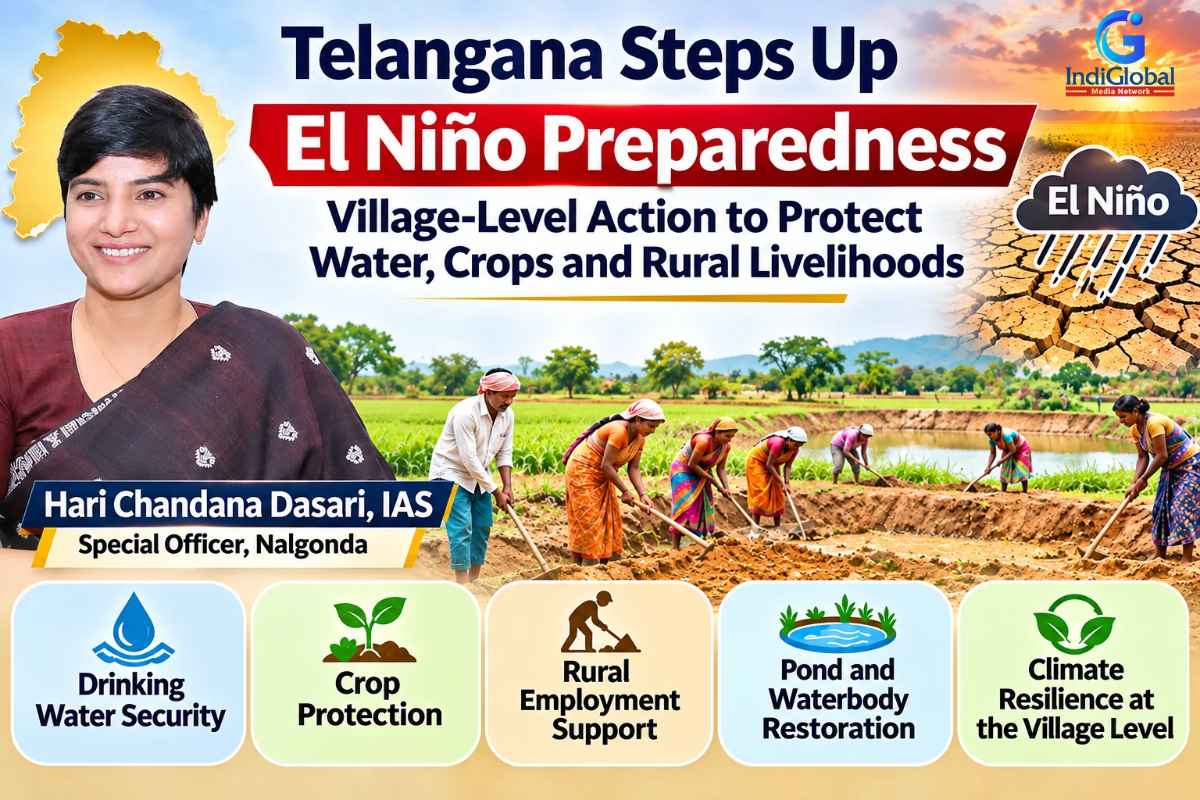
As Telangana prepares for the consequences of deficient rainfall and El Niño-linked weather conditions, senior IAS officer Dasari Hari Chandana has called attention to a dimension of drought that extends beyond water shortages and damaged crops: the loss of income for rural families.
In a recent public reflection on drought preparedness, Hari Chandana, who is serving as special officer for the erstwhile Nalgonda district, emphasised that falling agricultural activity can affect daily wages, household finances, migration decisions and food security. Her central argument is that water management, farming and employment support need to be planned together rather than treated as separate administrative challenges.
The officer drew attention to the Telangana government’s announced plan for four months of additional employment support for workers after Sankranti, extending towards May. She noted that the state intends to supplement available central funding and has sought additional employment days under the rural employment framework. The proposed support is intended to cushion families if drought conditions reduce agricultural work; the precise rollout and eligibility will depend on subsequent government implementation.
Also Read:- From Collector to Coach: IAS Hari Chandana Dasari is Mentoring the Next Generation of UPSC Aspirants
The approach also offers an opportunity to build long-term resilience. Labour-intensive works involving the restoration of village ponds, canals, access roads and other community assets could provide wages while improving the infrastructure on which rural communities depend. Such work, Hari Chandana suggested, can respond to immediate financial stress and help villages prepare for future periods of water scarcity.
The concerns are especially relevant in southern Telangana. During an October review in Nalgonda involving officials from Nalgonda, Suryapet and Yadadri-Bhongir, Hari Chandana called for detailed local plans to manage drinking water, groundwater, irrigation and electricity needs. Drinking water availability was identified as the first priority, with officials asked to examine resources at village level and prepare plans for the coming months.
The review also called for coordination among district administrations and local officials, including regular discussions with village representatives. By examining the condition of tanks, reservoirs, groundwater and crops, authorities aim to identify shortages early enough to respond before they become more severe.
Hari Chandana also visited agricultural fields in Kanagal mandal where paddy and cotton crops had shown signs of water stress. Farmers were advised to exercise caution over water-intensive paddy cultivation in the coming yasangi season, particularly where irrigation depends on borewells and wells.
The broader state response has gathered urgency. Telangana has declared 365 mandals drought-affected for the 2026 kharif season, according to the state’s reported notification. The government has also reviewed contingency planning for drinking water, agriculture, irrigation and power supply, while seeking additional central assistance and employment support.
The latest discussion shifts the focus from drought relief alone to anticipatory governance. For a family dependent on seasonal farm work, the disappearance of wages can become a crisis even before a village runs out of drinking water. Timely local employment, supported by useful public works, could therefore become an important part of drought preparedness.
Hari Chandana has invited farmers, administrators and rural workers to suggest the kinds of community projects that would create the greatest value during a difficult season. The question underscores the importance of local participation: a plan shaped around each village’s actual needs may be more useful than a uniform response imposed after distress has already intensified.
As Telangana moves into the coming months, the effectiveness of its response will depend not only on announcements but on how quickly district-level assessments turn into dependable water arrangements, appropriate crop guidance and accessible livelihood support. The emerging lesson is clear: protecting rural communities from climate stress requires safeguarding both their natural resources and their means of earning a living.