

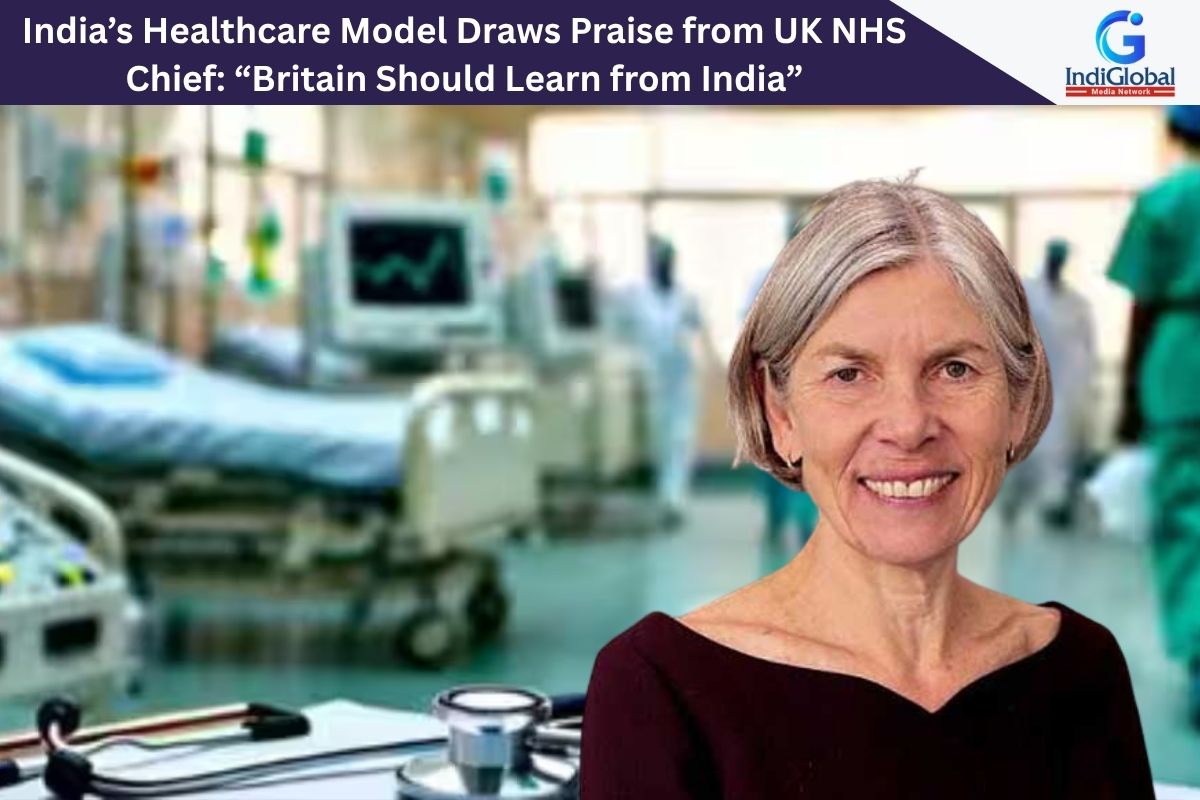
London, United Kingdom: In a striking recognition of India’s changing healthcare landscape, Dr Penny Dash, Chair of NHS England, has said that Britain should look to India and learn from the country’s healthcare system.
Her comments highlight a significant shift in the way India’s healthcare capabilities are being viewed internationally. Once largely discussed in terms of challenges such as access and affordability, India is increasingly being recognised for the scale, innovation and evolution of its healthcare sector.
Dash suggested that India could soon emerge as a global benchmark in healthcare, with other countries looking towards the country for practices and approaches they could adopt.
Why India is attracting global attention
India has built a healthcare ecosystem that combines a large public health network with a rapidly expanding private sector, specialised hospitals, medical technology and a growing digital-health ecosystem.
The country’s healthcare sector has also increasingly embraced technologies such as telemedicine, artificial intelligence, digital health records and remote consultations. These developments have helped healthcare providers explore ways of reaching patients beyond major metropolitan centres.
For a country as large and diverse as India, the ability to deliver healthcare at scale has become one of its most important strengths.
A different perspective from Britain
The comments come at a time when healthcare systems across the world are facing mounting pressure from ageing populations, rising demand for specialised treatment, workforce challenges and increasing healthcare costs.
The UK’s National Health Service has itself been navigating significant pressures. Against this backdrop, Dash’s remarks underline the value of looking beyond traditional healthcare models and learning from systems that have developed different ways of delivering care.
Rather than viewing healthcare innovation as something that flows only from developed countries to developing nations, her comments point towards a more global exchange of ideas with India potentially becoming a country from which others can learn.
India’s healthcare journey
India’s healthcare story is complex. While the country continues to face challenges involving affordability, uneven access and differences in healthcare infrastructure between regions, it has simultaneously developed world-class capabilities in several areas.
Indian hospitals and healthcare professionals have gained international recognition for advanced medical procedures, while the country’s pharmaceutical industry, medical technology sector and growing digital-health infrastructure have strengthened its position in global healthcare.
The combination of scale, relatively affordable treatment and increasing technological capability has also made India an important destination for medical care and healthcare innovation.
Could India become a global healthcare benchmark?
Dash’s comments raise an interesting possibility: that India’s healthcare innovations could increasingly influence healthcare policy and delivery models in other countries.
The idea is not necessarily that Britain should replicate India’s healthcare system entirely. Instead, lessons from India’s experience, including its ability to operate across a vast population, combine different healthcare providers and increasingly use technology to extend access, could offer useful ideas for countries dealing with their own healthcare pressures.
A moment of recognition for India
The remarks are significant because they represent recognition from a senior figure at the helm of one of the world’s best-known public healthcare systems.
For India, the message is both encouraging and challenging. Global recognition can celebrate the progress already made, but it also highlights the need to continue addressing gaps in accessibility, affordability and quality.
India’s healthcare journey is therefore far from complete. But as its medical capabilities, technology and healthcare infrastructure continue to expand, the country is increasingly becoming not just a recipient of global healthcare ideas, but a potential source of them.