

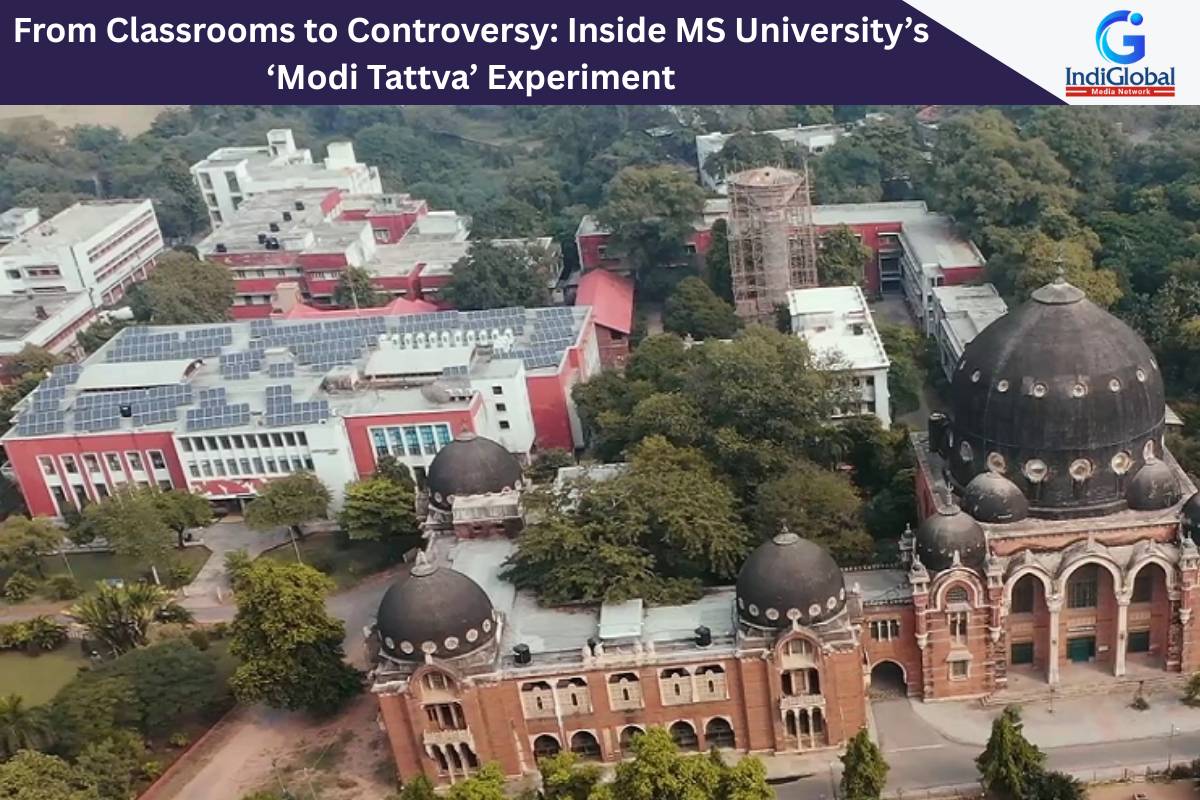
In a move that is sparking both curiosity and debate, the Maharaja Sayajirao University (MSU) of Baroda in Vadodara has introduced a new set of sociology courses that bring contemporary politics directly into the classroom. At the centre of this academic shift is a module called “Modi Tattva,” alongside lessons on the ideology of the Rashtriya Swayamsevak Sangh (RSS).
For many students, this marks a departure from traditional sociology curricula rooted in classical theories and historical case studies. Instead, they are now being asked to engage with living political ideas and leadership styles, something that feels both immediate and, for some, controversial.
The “Modi Tattva” module focuses on the leadership, governance approach, and public communication style of Prime Minister Narendra Modi. Students will analyse his policies and initiatives—such as large-scale development programmes, through a sociological lens, examining their impact on society and public perception.
What makes the course distinctive is its attempt to bridge theory with contemporary practice. Drawing from sociologist Max Weber’s concept of “charismatic authority,” the curriculum frames Modi as a case study in modern leadership, allowing students to explore how personal image, communication, and governance intersect in shaping public opinion.
But the changes don’t stop there. The revamped syllabus also introduces modules on RSS ideology, fieldwork, and broader themes such as nationalism, Hindu sociology, and Indian knowledge systems. These additions aim to align academic study with what university officials describe as “contemporary governance and lived social realities” in India.
Supporters of the move argue that sociology, as a discipline, must evolve with the times. They believe that studying current political figures and organisations offers students a more relevant and applied understanding of society. University representatives have pointed to growing student interest in modern governance models and their social impact, suggesting that such courses could make learning more engaging and practical.
Also Read:- No ‘Insta Babu’ Era: Why India’s Future IAS & IPS Officers Are Being Told to Log Off and Look Within
However, the decision has not been without criticism. Some academics and political voices have raised concerns about the potential politicisation of education, questioning whether the inclusion of specific ideological perspectives could compromise academic neutrality. Others worry that the shift may overshadow the diversity of sociological thought by prioritising certain narratives over others.
For students on campus, reactions are mixed. While some see this as an opportunity to study real-world leadership up close, others are navigating the tension between academic inquiry and political sensitivity. In classrooms where theories once revolved around long-past thinkers, discussions are now likely to touch on present-day governance, identity, and nationalism, topics that resonate far beyond university walls.
Ultimately, MSU’s new curriculum reflects a broader question facing higher education today: should universities remain detached observers of society, or active interpreters of its current realities? As this experiment unfolds, the answer may lie not just in policy decisions, but in how students engage, question, and shape the discourse themselves.