

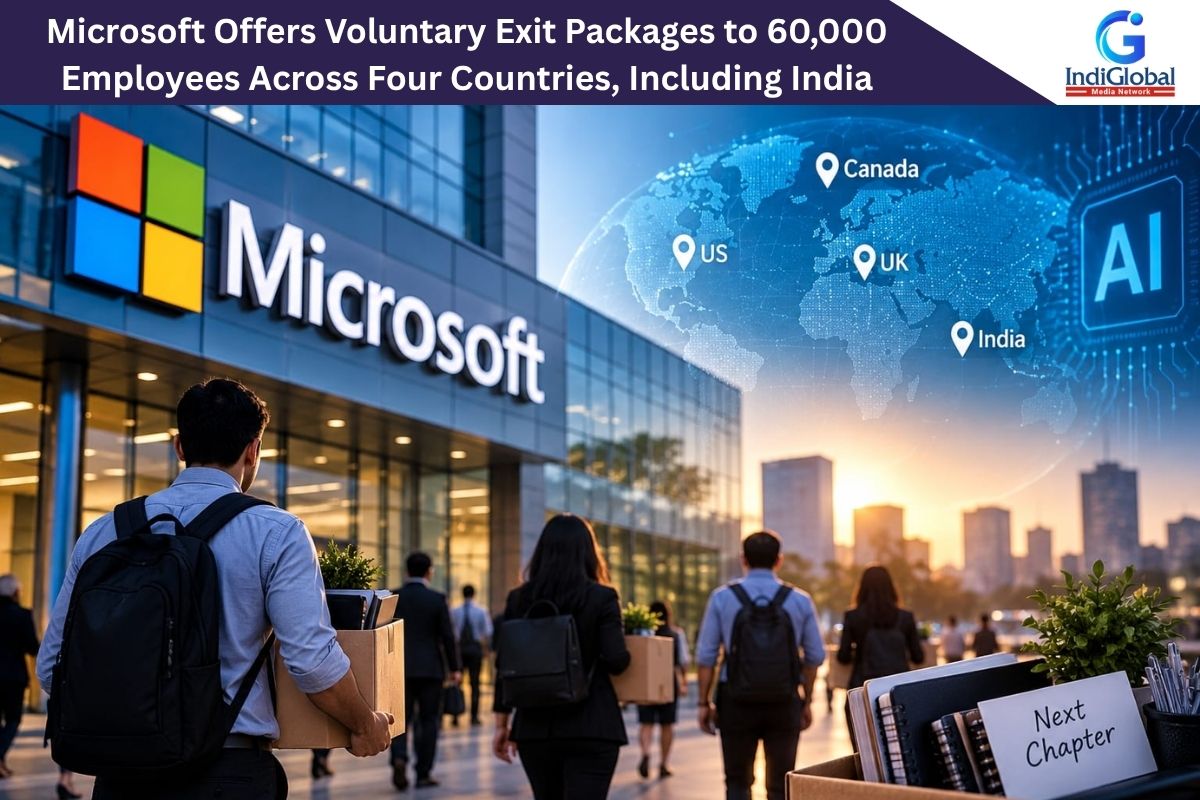
Microsoft has introduced a voluntary exit programme covering approximately 60,000 eligible employees across India, the United States, the United Kingdom and Canada, marking a significant development in the technology giant’s ongoing efforts to reshape its workforce.
The initiative, announced on October 26, offers eligible employees an opportunity to leave the organisation with financial compensation and career transition support.
Unlike conventional layoffs, the programme allows employees in participating teams to decide whether they wish to accept the exit package. Microsoft has not announced how many employees are expected to take up the offer.
The development comes at a time when the company is investing heavily in artificial intelligence, cloud computing and the infrastructure required to support increasingly sophisticated AI technologies.
What Does the Voluntary Exit Programme Mean?
Under the programme, eligible Microsoft employees can choose to leave the company in exchange for financial support intended to help them manage their transition to new employment or other career opportunities.
The offer applies to selected employees in participating teams rather than the company’s entire workforce. While approximately 60,000 employees are reportedly eligible, this does not mean that an equivalent number of jobs will necessarily disappear.
The final impact will depend on how many employees accept the offer and how Microsoft reorganises the affected teams.
Why Is Microsoft Restructuring Its Workforce?
The announcement comes against the backdrop of major changes sweeping through the global technology industry.
Artificial intelligence is rapidly influencing how technology companies develop software, manage operations, serve customers and organise their workforce.
Microsoft has emerged as one of the world’s leading investors in AI, expanding its cloud infrastructure, data centre capacity and AI-powered products. These investments require substantial financial resources, prompting technology companies to review their operating costs and workforce requirements.
However, it would be premature to conclude that Microsoft’s voluntary exit programme is entirely the result of artificial intelligence replacing human workers. Workforce restructuring can involve several factors, including changing business priorities, operational efficiency and the redistribution of resources towards emerging technologies.
What Could This Mean for Employees in India?
India is among the four countries covered by the programme, making the announcement particularly relevant to the country’s technology workforce.
Microsoft has a significant presence in India, with operations spanning engineering, research, cloud services, customer support and business functions.
For eligible employees, the programme presents a decision that involves weighing immediate financial compensation against long-term career opportunities.
The announcement also comes at a time when India’s technology professionals are adapting to changing industry expectations, particularly the growing demand for skills in artificial intelligence, cloud computing, cybersecurity and data engineering.
The number of India-based employees eligible for the programme and the number likely to accept the offer have not been separately established.
Is Artificial Intelligence Changing the Future of Technology Jobs?
Microsoft’s announcement adds to a wider debate about how artificial intelligence will influence employment in the years ahead.
AI tools are increasingly capable of assisting with coding, documentation, customer service, data analysis and routine business processes. While these technologies can improve productivity, they are also changing the skills employers expect from their workforce.
At the same time, artificial intelligence is creating demand for new roles in AI engineering, machine learning, cybersecurity, data infrastructure and technology governance.
For professionals, the challenge is no longer simply understanding emerging technologies but learning how to work effectively alongside them.
What Happens Next?
Attention will now turn to the response from eligible Microsoft employees and the extent to which the programme changes the company’s workforce.
The actual number of departures, the geographical distribution of employees accepting the packages and the longer-term organisational impact remain to be seen.
For the global technology industry, the announcement reflects a broader period of transition as major companies balance investment in emerging technologies with the need to manage costs and maintain competitiveness.
For India’s technology workforce, it is another reminder that the skills required to build a sustainable career are evolving rapidly.
The larger question is not simply how many employees may choose to leave Microsoft, but how the global technology industry will redefine jobs, skills and career opportunities in an increasingly AI-driven economy.