

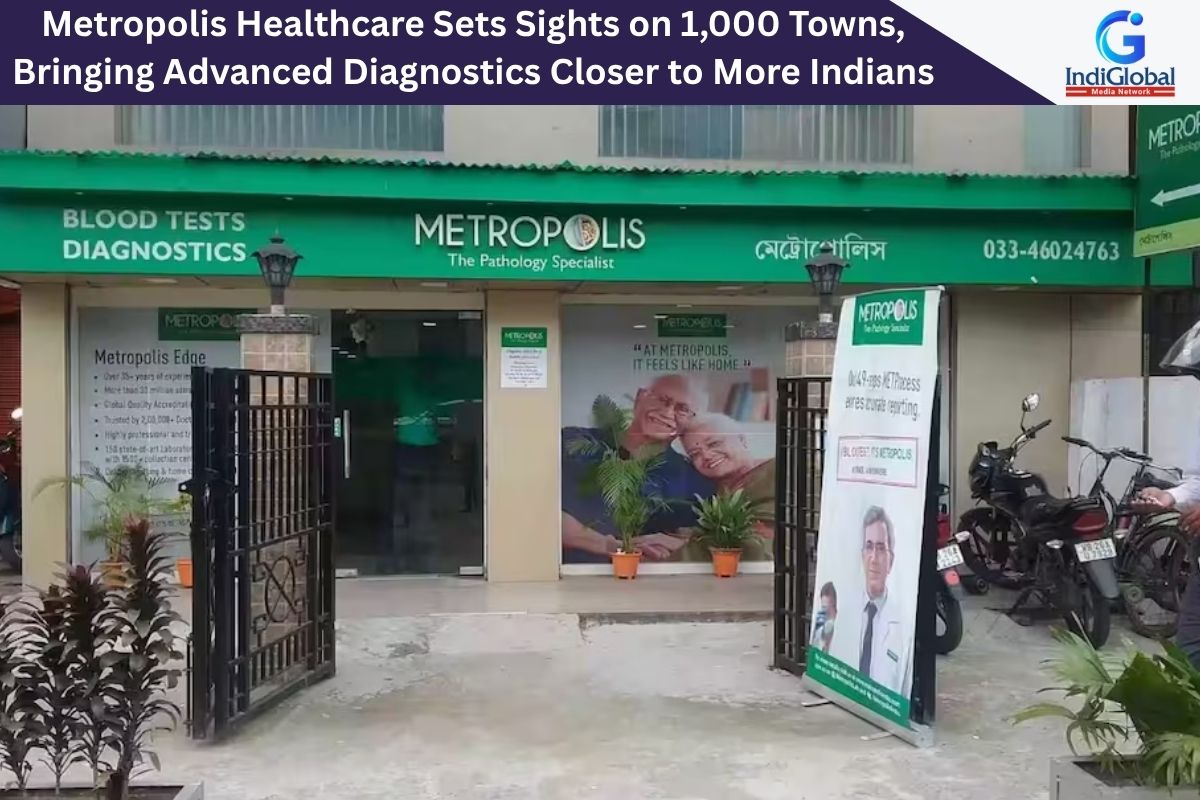
Maharashtra: Access to reliable diagnostic testing is becoming an increasingly important part of healthcare, particularly as patients in smaller towns look for quality services closer to home. In a major expansion push, Metropolis Healthcare has announced plans to extend its presence to 1,000 towns across India over the next three years, up from around 750 towns currently.
The expansion is part of the company’s new acceleration phase, which focuses on widening its geographical reach while making its existing diagnostic network more efficient.
2,500 new collection centres planned
Metropolis currently operates more than 5,000 collection centres and 209 laboratories, with its network extending across India and five African countries. The company plans to add approximately 2,500 collection centres as it expands its footprint.
It also wants to increase its company-owned centres from the current 750 to around 1,000, particularly strengthening its presence in major cities while simultaneously reaching more locations across the country.
The expansion reflects a broader shift in India’s diagnostic sector, where organised healthcare providers are increasingly seeking to reach patients beyond major metropolitan centres.
Technology to become a bigger part of diagnostics
The company’s growth strategy is not limited to adding physical centres. Metropolis plans to increasingly use technology and artificial intelligence to improve productivity, workflows and turnaround times.
Managing Director Surendran Chemmakotil said the company intends to transform itself into a technology-driven organisation over the next three years, with AI already being deployed in non-scientific processes.
For patients, greater use of technology could mean faster processes and more efficient diagnostic services as the network expands.
Mini-hubs to combine pathology and radiology
Another major part of the strategy is the creation of approximately 100 mini-hubs over the next three years.
These centres are expected to offer basic radiology services alongside pathology, potentially allowing patients to access multiple diagnostic services from a single location rather than travelling to different facilities.
Such a model could be particularly useful in smaller cities and towns, where access to specialised diagnostic infrastructure can be more limited.
A largely unorganised diagnostic market
Metropolis Executive Chairperson Ameera Shah noted that India’s diagnostic industry is valued at around USD 11 billion and is growing at approximately 11 per cent annually. However, around 85 per cent of the sector remains unorganised.
The company sees this as an opportunity for organised diagnostic chains to expand through standardised centres, technology and specialised testing.
Metropolis ended FY26 with revenues of ₹1,646 crore, while patient volumes increased 12 per cent and test volumes rose 13 per cent during FY24-26.
The bigger picture: healthcare beyond major cities
The planned expansion highlights an important trend in Indian healthcare, the growing effort to take organised and technology-enabled medical services beyond the country’s biggest cities.
For patients in smaller towns, the availability of dependable diagnostic facilities can reduce the need to travel long distances for routine and specialised tests. At the same time, expanding networks could help diagnostic companies build stronger links between local collection centres and advanced laboratories.
Metropolis is targeting an increase in its EBITDA margin from 24.5 per cent to 28 per cent over the next three years, supported by better asset utilisation, operating efficiencies and automation. It is also targeting annual organic revenue growth of around 14-15 per cent, excluding acquisitions.
A push towards wider, smarter healthcare access
The company’s plan to reach 1,000 towns is therefore more than a numbers game. It reflects the changing nature of India’s healthcare landscape, where patients increasingly expect convenient access to quality diagnostics, faster services and technology-driven healthcare.
If the expansion progresses as planned, more people outside India’s major urban centres could gain access to organised diagnostic services without having to travel to distant cities.