

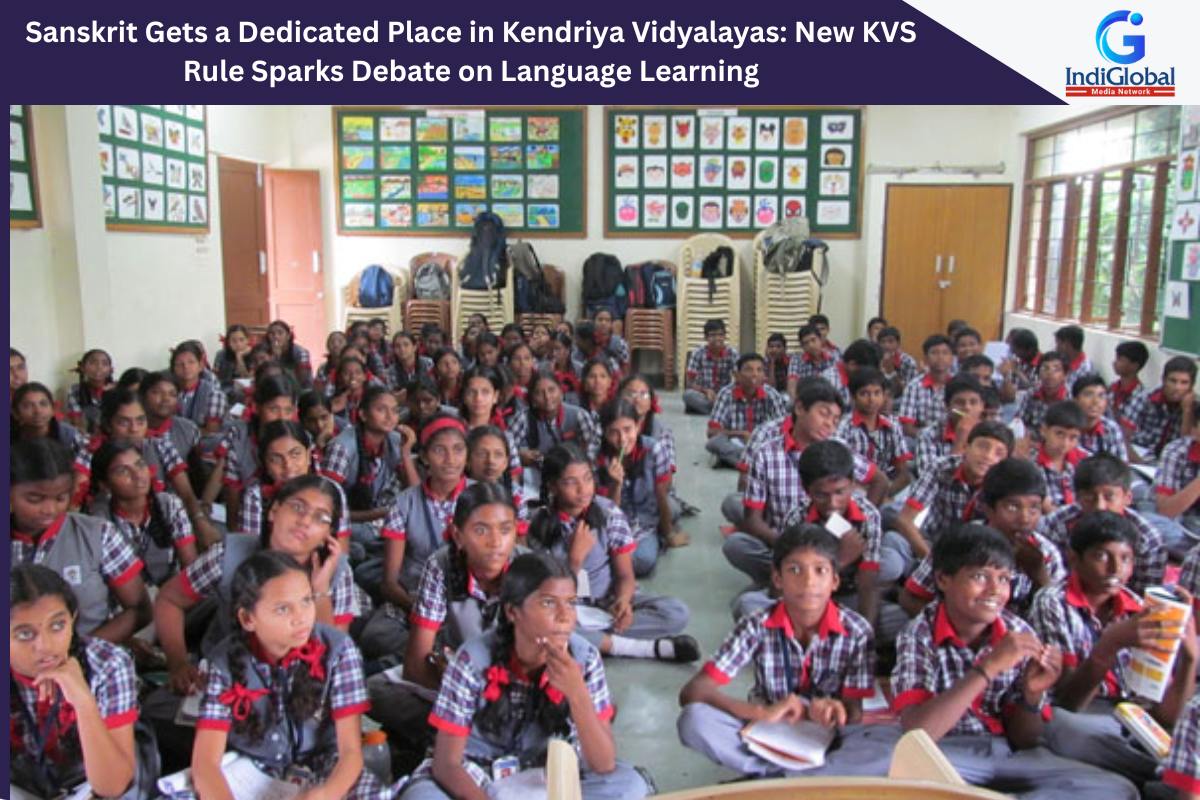
Delhi: In a significant move aligned with India’s evolving education policy, the Kendriya Vidyalaya Sangathan (KVS) has directed all Kendriya Vidyalayas across the country to maintain at least one Sanskrit section in Classes 6 and 9 from the 2026-27 academic session. The decision forms part of the implementation of the revised third-language framework and is expected to impact thousands of students studying in the centrally administered school system.
The announcement comes at a time when schools across the country are adapting to the language-learning vision outlined in the National Education Policy (NEP) 2020 and the National Curriculum Framework for School Education (NCF-SE) 2023. While students will continue to have a choice between Sanskrit and regional languages, the new directive ensures that Sanskrit remains available as an option in every Kendriya Vidyalaya.
A New Structure Under the Three-Language Framework: According to the circular issued by KVS, students in Classes 6 and 9 will study Hindi as the first language (R1) and English as the second language (R2). For the third language (R3), they can choose either Sanskrit or a regional/state language included among India’s scheduled languages.
School authorities have been instructed to collect language preferences from students and parents and upload the data through the Samagam portal. The information will be used to determine staffing requirements and organize sections based on student choices.
Why Sanskrit Sections Are Being Made Mandatory: KVS officials have clarified that students are not being forced to study Sanskrit. Rather, the mandate requires schools to ensure that at least one Sanskrit section is available in every institution so that students who wish to study the language can do so, particularly children of transferable central government employees who may move frequently between states.
The move reflects a broader effort to preserve access to classical Indian languages while accommodating the mobility of families served by the Kendriya Vidyalaya system. Supporters argue that a uniform Sanskrit option across schools can provide continuity for students who relocate during their schooling years.
How Schools Will Implement the Rule: The arrangement of language sections will vary according to student strength and school size. Schools with a single section may create separate Sanskrit and regional-language groups if at least 15 students opt for each language.
Schools with two sections can maintain one Sanskrit section and one regional-language section.
Schools with three or more sections may distribute students according to demand, but at least one Sanskrit section must be maintained.
KVS has also directed schools to group students choosing the same third language together to ensure smoother classroom instruction and efficient deployment of teachers.
Part of a Larger Educational Shift: The directive follows recent changes introduced by the Central Board of Secondary Education (CBSE), which has made the study of three languages compulsory for Class 9 students, including at least two Indian languages. The reforms are intended to bring school curricula in line with the NEP’s emphasis on multilingual education and cultural literacy.
Under the revised framework, students who wish to study foreign languages may do so only after fulfilling the requirement of learning two Indian languages. CBSE has also stated that there will be no separate Class 10 board examination for the third language to avoid increasing academic pressure on students.
Praise, Concerns, and Practical Challenges: The policy has generated mixed reactions among educators and parents. Supporters see it as an opportunity to strengthen knowledge of India’s linguistic and cultural heritage while promoting multilingual learning. They argue that Sanskrit’s influence on many Indian languages makes it a valuable academic subject.
However, some education experts have raised concerns about the availability of qualified Sanskrit teachers, especially in regions where demand for regional languages may be significantly higher. Questions have also emerged about how schools with limited resources will balance staffing requirements while accommodating diverse language preferences.
More Than a Language Policy: Beyond classroom schedules and subject choices, the decision highlights a broader conversation about identity, heritage, and the role of language in modern education. As India continues implementing the reforms envisioned under the NEP, language education is emerging as one of the most closely watched areas of change.
For students entering Classes 6 and 9 in Kendriya Vidyalayas next year, the new policy means one thing is certain: Sanskrit will have a guaranteed place in every school, even as students retain the freedom to choose the language path that best suits their interests and aspirations.