

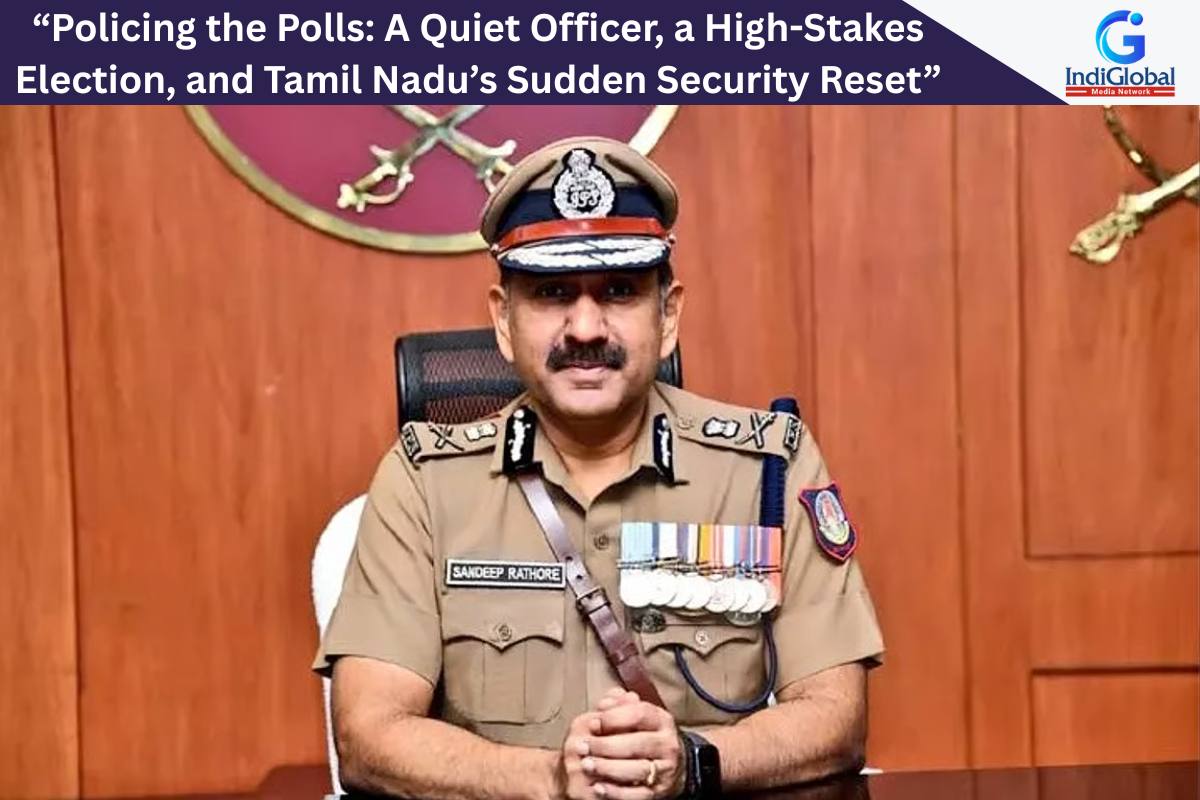
As Tamil Nadu edges closer to a fiercely watched Assembly election, a quiet but powerful reshuffle in the state’s police leadership is reshaping the ground beneath the political contest. At the centre of it is one man, Sandeep Rai Rathore, tasked with ensuring that democracy runs smoothly in one of India’s most politically vibrant states.
A Decision That Signals Urgency
Just weeks before voters head to the polls on April 23, 2026, the Election Commission of India (ECI) stepped in with decisive action: it replaced the state’s acting police chief, G. Venkataraman, with Rathore as the new Director General of Police (DGP).
This wasn’t just routine bureaucracy. The move followed mounting pressure from opposition parties demanding a neutral administrative setup to guarantee free and fair elections.
In election season, perception is everything, and the ECI’s message was clear: neutrality must not just exist, it must be seen.
Who Is Sandeep Rai Rathore?
A 1992-batch IPS officer, Rathore is no stranger to high-pressure roles. Known within policing circles for his administrative depth, he has previously served as Chennai Police Commissioner and held key roles at the national level, including with disaster response forces.
Colleagues describe him as methodical rather than flashy, a trait that may prove crucial in an election where tensions can escalate quickly.
Now, he inherits a system that must balance law enforcement with political sensitivity, all under the scrutiny of voters, parties, and the Election Commission.
A Wider Shake-Up Across Cities
Rathore’s appointment was only the headline act. The ECI simultaneously restructured key policing positions across Tamil Nadu:
- Sanjay Kumar appointed Commissioner of Police, Tambaram
- Abhishek Dixit posted as Commissioner of Police, Madurai
- R.V. Ramya Bharati moved to Inspector General (West Zone)
These changes matter on the ground. Cities like Tambaram, part of the rapidly expanding Chennai metropolitan region, and Madurai, a politically sensitive urban hub, are often hotspots during elections.
Also Read:- IAS Shake-Up: Seasoned Leaders Step Up to Drive India’s Governance Forward
By placing new leadership in these regions, the ECI is effectively recalibrating the state’s law-and-order machinery ahead of polling day.
The Human Side of a Systemic Move
Behind the official orders lies a deeper story: the pressure on institutions to maintain trust.
Elections in Tamil Nadu are not just administrative exercises, they are emotional, identity-driven, and intensely competitive. With over 56 million registered voters, even minor lapses in law and order can ripple into major controversies.
For Rathore and his newly appointed colleagues, the challenge isn’t just policing, it’s reassurance. Every deployment, every decision, and every response will be read as a signal of fairness or bias.
Why This Matters Now
This reshuffle comes at a time when:
- Campaigns are intensifying
- Political rhetoric is sharpening
- Public gatherings are increasing in size and frequency
The ECI has also made it clear that transferred officers will not be given election-related duties until polling concludes, another safeguard aimed at preserving neutrality.
In effect, the Commission is not just changing personnel, it is attempting to engineer confidence.
The Road Ahead
As Tamil Nadu moves toward polling day, the spotlight will remain firmly on how effectively this new police leadership maintains order without overreach.
For voters, these changes may seem distant. But on election day, when they stand in line at polling booths, the quiet presence of a neutral and efficient police force will shape their experience of democracy.
And for Sandeep Rai Rathore, the task is simple in theory, but immense in practice:
to ensure that in a state alive with political passion, the rule of law remains calm, steady, and unquestioned.