
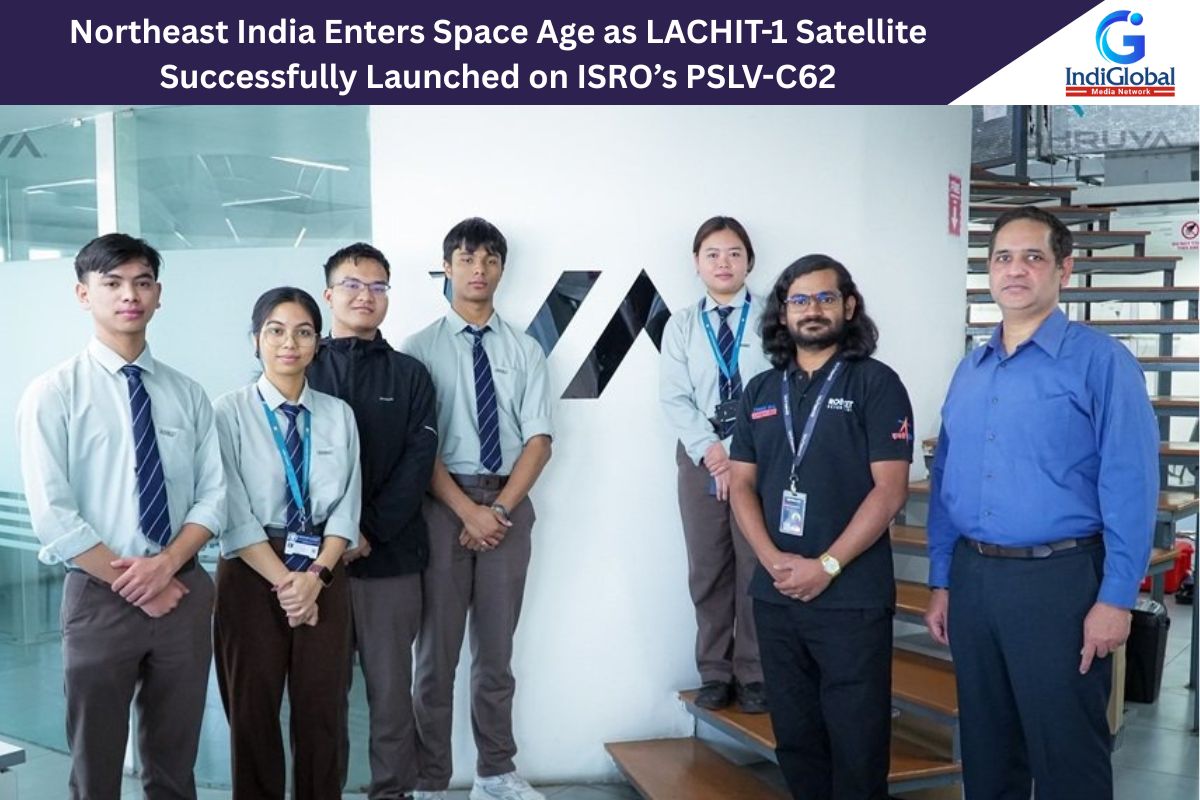
Guwahati: Northeast India marked a defining moment in its scientific journey as LACHIT-1, the region’s first satellite, was successfully placed into orbit aboard Indian Space Research Organisation’s PSLV-C62 mission.
The satellite, developed by Assam Don Bosco University (ADBU), was launched from the Satish Dhawan Space Centre, Sriharikota, as part of a multi-satellite mission that also carried India’s primary Earth-observation payload along with several co-passenger satellites from academic and research institutions.
Named Live Amateur Communication Hub for Innovative Technologies-One (LACHIT-1), the satellite pays tribute to legendary Ahom general Lachit Borphukan, symbolising courage, innovation and regional pride. The project represents the first time a university from Northeast India has designed, built and operated a satellite, placing the region firmly on India’s space map.
Student-Led Innovation in Space
LACHIT-1 is the result of years of hands-on work by students and faculty members of ADBU, with technical integration support from India’s private space ecosystem. From system design and payload integration to testing and mission readiness, students were actively involved in every phase of development — a rare achievement in university-driven space missions.
Also Read:- Transparent ADRE 2.0 Recruitment Brings 4,374 Youth Into Government Service
The satellite is equipped with a store-and-forward communication payload using amateur radio frequencies, enabling it to receive, store and retransmit short messages as it passes over ground stations. Such capabilities are especially relevant for emergency and disaster-response communication, particularly in remote and connectivity-challenged regions like the Northeast.
A dedicated mission control and ground station has been established at ADBU’s campus near Guwahati to track the satellite and manage post-launch operations.
Boost to Academic Space Ecosystem
The successful deployment of LACHIT-1 highlights the growing role of universities and students in India’s expanding space ecosystem, traditionally dominated by national agencies. It also reflects ISRO’s increasing collaboration with academic institutions and private players, enabling broader access to space technologies.
For Northeast India, the mission goes beyond a technological milestone. It opens new pathways for space education, research, innovation and youth participation, inspiring future satellite missions from the region and strengthening India’s decentralised space capabilities.
As LACHIT-1 begins its journey around Earth, it carries with it the aspirations of a region — proving that world-class space innovation can emerge from classrooms, campuses and young minds far from traditional space hubs.