
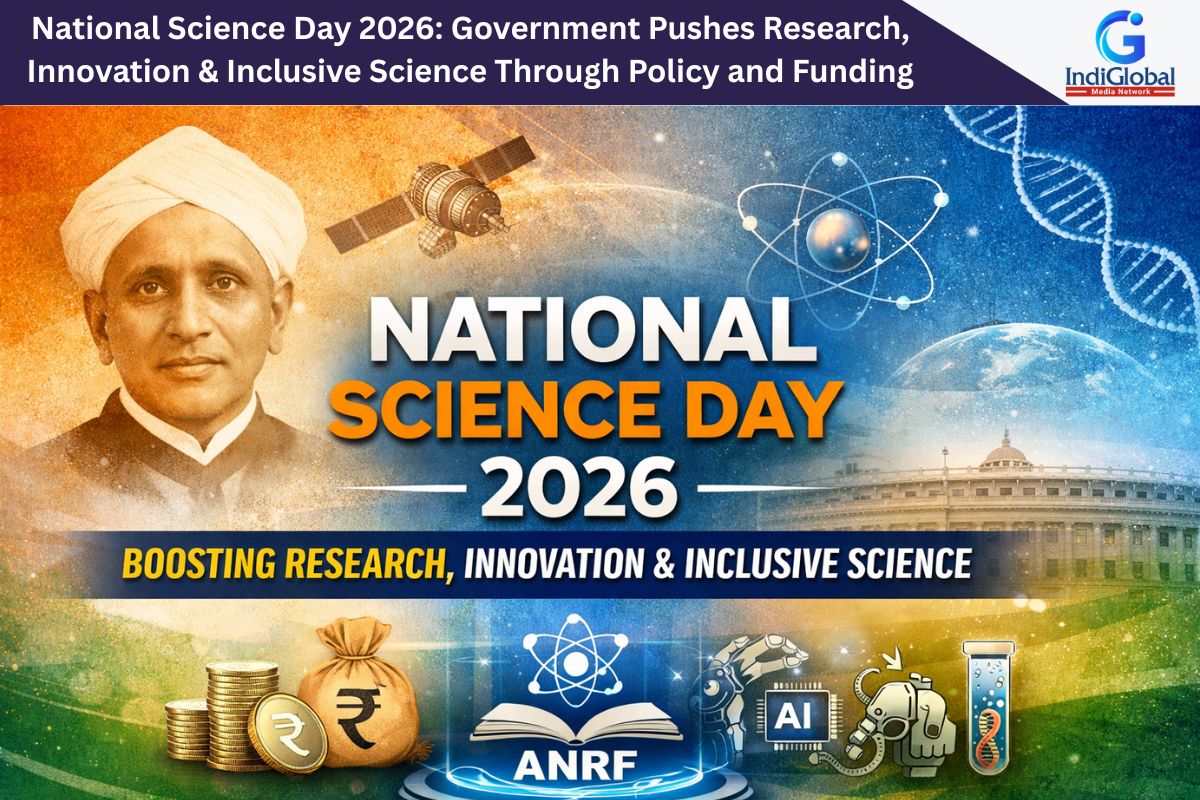
New Delhi, February 28: India marks National Science Day today, commemorating Sir C. V. Raman’s discovery of the Raman Effect and reaffirming the country’s commitment to science-led development. This year, the observance comes amid a strong policy push by the Government of India to scale up research funding, strengthen innovation ecosystems, and expand scientific access across society.
Rising Budgetary Commitment to Science & Research
The Union Government has steadily increased allocations to scientific departments over recent years, signalling a long-term strategy to position science and technology as drivers of economic growth and strategic autonomy.
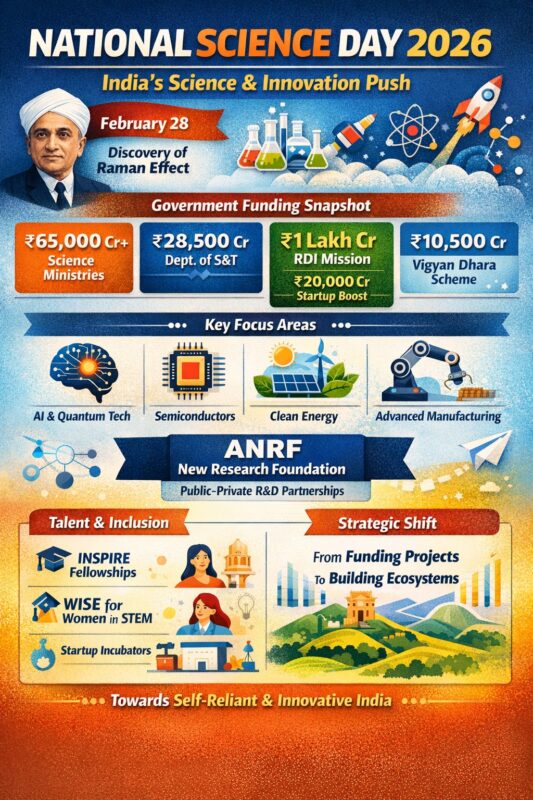
- More than ₹65,000 crore has been allocated to six key scientific agencies for FY 2025-26 — the highest level in five years.
- These agencies include the Department of Science & Technology (DST), CSIR, Department of Biotechnology, Department of Space, Department of Atomic Energy, and Ministry of Earth Sciences.
- DST alone received over ₹28,500 crore, the largest share among them.
This upward trajectory reflects the government’s emphasis on strengthening national R&D capacity and building technological self-reliance.
₹1 Lakh-Crore Research & Innovation Push
A major structural reform in India’s science funding architecture is the creation of a Research, Development and Innovation (RDI) Fund aimed at catalysing private-sector participation in high-risk, high-technology sectors.
- The Union Budget allocated ₹20,000 crore to kickstart this initiative and operationalise a proposed ₹1 lakh-crore R&D fund.
- The fund is designed to support deep-tech and sunrise sectors while encouraging industry-led innovation.
- The 2026 Budget further topped up this initiative, signalling sustained government backing for long-gestation research investments.
Policy experts note that such patient capital is critical because breakthrough technologies often require long development cycles before commercial viability.
Institutional Reforms: ANRF and New Funding Models
To provide strategic direction and coordinate research investments, the government established the Anusandhan National Research Foundation (ANRF) under a 2023 Act.
- The ANRF framework encourages participation from both public and private sectors in funding scientific research.
- New hybrid funding models and public-private partnerships are being promoted to increase industry share in national R&D spending.
This marks a shift from government-driven research to a more collaborative innovation ecosystem.
Scheme-Based Investments: From Fellowships to Unified Programmes
Several targeted schemes continue to support researchers, startups, and young scientists:
- Fellowships such as INSPIRE, WISE, and other youth-oriented programmes provide direct financial and career support to emerging researchers.
- The unified Vigyan Dhara programme consolidates multiple science schemes with an outlay exceeding ₹10,500 crore for 2021-22 to 2025-26.
These programmes aim to strengthen the talent pipeline while improving efficiency in fund utilisation.
Sector-Specific Allocations: Biotechnology, Industrial Research & Emerging Tech
Budgetary provisions have also targeted specific high-impact sectors:
- Biotechnology initiatives, including the Bio-RIDE scheme, received an outlay of about ₹2,300 crore to promote research, entrepreneurship, and biomanufacturing.
- CSIR and related industrial research institutions saw allocations exceeding ₹6,600 crore to support applied research and innovation.
Simultaneously, national missions – such as deep-ocean exploration-continue to receive multi-year funding to build capabilities in frontier science domains.
Deep-Tech, Start-Ups and Future Technologies
Government initiatives increasingly focus on emerging technologies such as AI, quantum computing, robotics, and advanced communications.
- The RDI framework aims to channel long-term capital into such sectors and reduce risks for private investors.
- State-level policies are aligning with this direction; for example, Gujarat’s proposed STI Policy includes dedicated innovation funds and mandates departmental R&D spending to boost indigenous technology development.
- Startup incubation and research parks, supported by targeted grants, are expanding beyond major metros to decentralise innovation.
Science for Society: Inclusion and Grassroots Outreach
National Science Day is also being used to promote inclusivity and scientific temper at the grassroots level.
- Initiatives such as a Braille-enabled science magazine launched in Gujarat aim to make STEM education accessible to visually impaired learners and encourage experiential learning.
This reflects a broader shift toward democratizing science education alongside high-end research investments.
The Larger Policy Message
The overarching direction of India’s science policy is clear:
move from isolated research funding to an integrated innovation ecosystem combining academia, industry, startups, and government support.
By scaling funding, creating institutional frameworks like ANRF, and backing deep-tech entrepreneurship, the government is positioning science and technology as central to India’s economic growth, self-reliance, and global competitiveness.
National Science Day 2026 is not merely commemorative – it underscores a strategic transition toward mission-driven research, higher public investment, and stronger private participation to transform India into a knowledge-powered economy.