
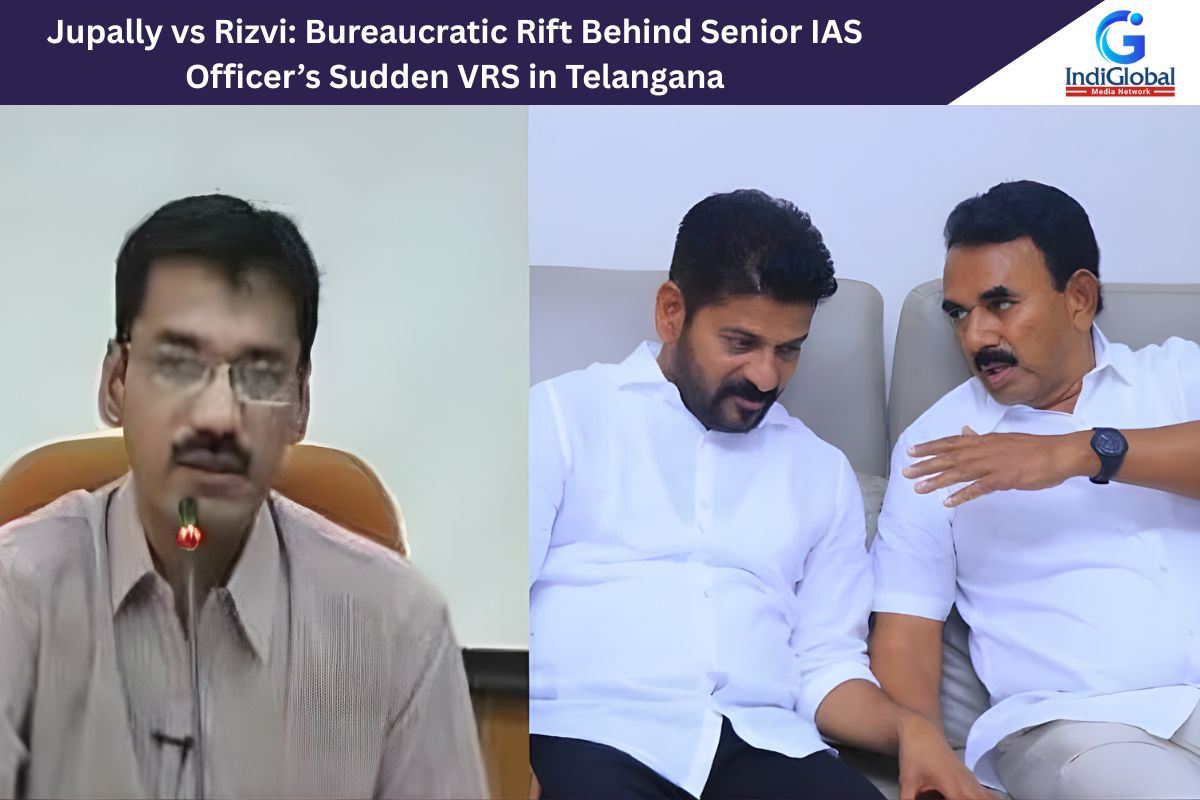
Hyderabad: In what has sent ripples through Telangana’s administrative circles, senior IAS officer Syed Ali Murtaza Rizvi, serving as Principal Secretary for Health and Commercial Taxes, has applied for voluntary retirement (VRS) effective October 31, 2025. His decision comes just days after Excise Minister Jupally Krishna Rao submitted a detailed complaint against him, accusing the officer of wilfully stalling a key tender process related to high-security liquor holograms.
What looks like a routine exit may in fact be the fallout of a deep bureaucratic–political rift — one that raises questions about accountability, transparency, and the fragile balance of power between ministers and senior officials.
The Tender That Triggered It All
The friction dates back to a tender for high-security holograms affixed to liquor bottles — an essential tool in excise tax enforcement and anti-counterfeiting. In August 2024, Minister Jupally Krishna Rao directed Rizvi and the Excise Commissioner to fast-track the tender process as per G.O.Ms. No. 112 (2022).
Also Read:- Telangana IAS Shuffle: Surendra Mohan to Agriculture, Raghunandan Rao to Taxes
However, despite multiple reminders, progress was slow. Rizvi reportedly proposed to reconstitute the expert committee handling the tender and sought to remove himself as its chairman — a move seen by the minister as a delay tactic. Instead of acting on the minister’s orders, Rizvi is said to have routed the file through the Chief Minister’s Office, further straining relations.
By April 2025, even as 23 companies submitted bids, the process remained incomplete, allowing the old vendor—whose contract had expired in 2019—to continue supply. On October 22, 2025, Minister Jupally formally complained against Rizvi, urging the government to reject his VRS and initiate disciplinary proceedings under Section 221 of the Bharatiya Nyaya Sanhita, citing deliberate non-compliance.
The Clash of Accountability and Authority
This episode underscores a defining tension within governance — where bureaucratic autonomy meets political authority. Senior officers like Rizvi are custodians of due process, but ministers, as elected representatives, hold the mandate to drive policy execution.
For Jupally, the delays symbolized bureaucratic resistance; for Rizvi, they may have reflected procedural prudence or caution in handling a sensitive, high-value tender.
Either way, the standoff exposes the thin line between ensuring accountability and maintaining administrative independence — a line increasingly tested in high-stakes government decisions.
A senior officer applying for VRS amid controversy rarely signals coincidence. Such exits often reflect mounting pressure, disillusionment, or an attempt to exit gracefully before a possible inquiry. The minister’s move to block the VRS suggests the government wants the issue investigated rather than buried.
Also Read:- Telangana HC Grants Temporary Respite to IAS Officer in Kaleshwaram Probe
Observers see this as part of a larger push by the new administration to tighten oversight on bureaucratic functioning — especially in revenue-generating departments like Excise and Commercial Taxes.
Beyond personalities, this controversy brings focus back to public procurement transparency. When tenders worth crores remain unresolved and old contracts linger, questions of integrity naturally arise. The outcome of this case will test whether Telangana’s governance model can combine speed with scrutiny, and autonomy with accountability.