
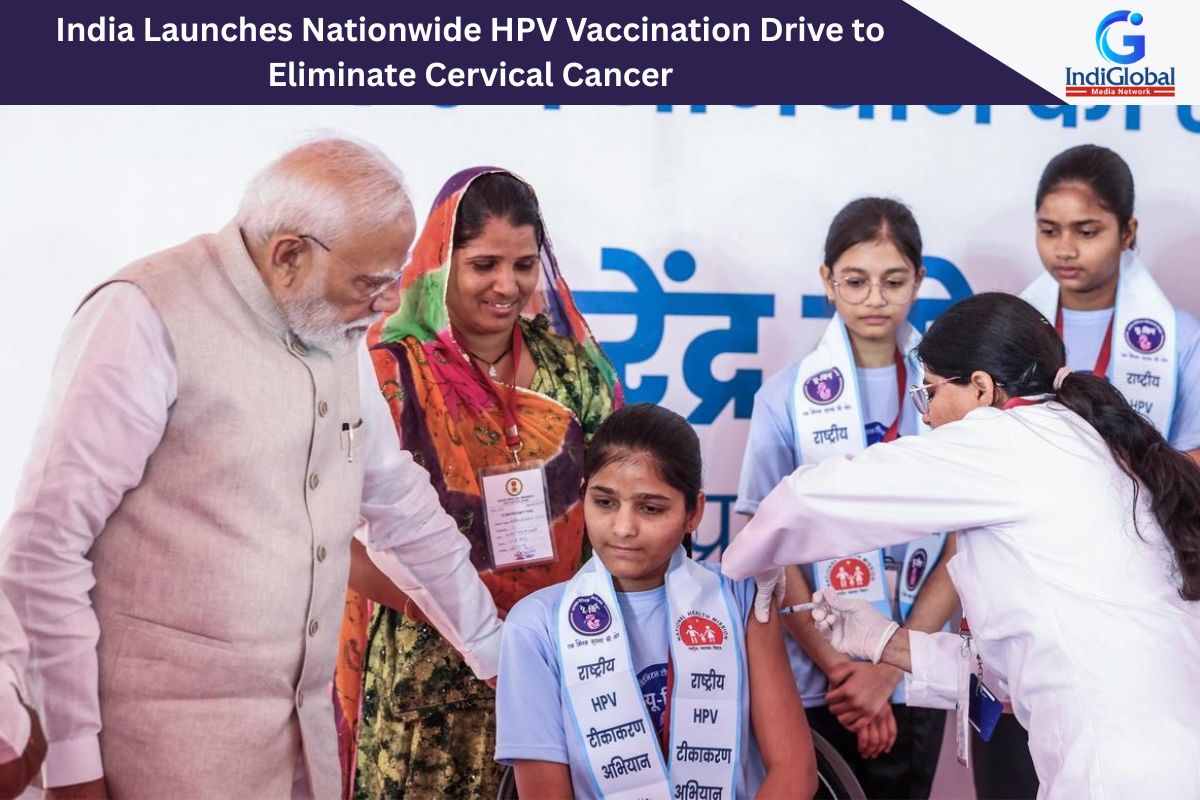
In a landmark step towards strengthening preventive healthcare for women, India has rolled out a nationwide Human Papillomavirus (HPV) vaccination drive aimed at protecting young girls from cervical cancer – one of the most preventable yet deadly cancers affecting women in the country.
The campaign marks a major public health shift, placing adolescent immunisation at the centre of India’s long-term cancer prevention strategy and integrating HPV vaccination into the broader Universal Immunisation Programme framework.
A Preventive Push Against a Silent Killer
Cervical cancer continues to be one of the leading causes of cancer-related mortality among Indian women, particularly due to late detection and limited screening coverage. Persistent infection with high-risk HPV strains – notably types 16 and 18 – is responsible for the majority of cases.
Medical research has consistently shown that vaccination during adolescence, before exposure to the virus, offers the highest level of protection, making early immunisation a cornerstone of global cervical cancer elimination strategies.
States Lead the Ground-Level Rollout
While the initiative is national in scope, states are playing a pivotal role in operationalising the campaign, tailoring implementation through schools, district health missions, and community outreach.
Several states and Union Territories have already initiated or announced structured rollouts, including:
- Andhra Pradesh – Launching state-wide drives through school-based vaccination and public health centres, with a focus on rural adolescent coverage.
- Rajasthan – Among the early states to operationalise the campaign following the national launch.
- Himachal Pradesh – Integrating HPV vaccination into its strong primary healthcare network.
- Haryana – Running awareness-linked immunisation sessions through district administrations.
- Bihar – Expanding adolescent health outreach under Rashtriya Kishor Swasthya Karyakram (RKSK) platforms.
- Kerala (select districts such as Ernakulam) – Leveraging high literacy and school enrolment for rapid coverage.
- Chandigarh (UT) – Undertaking urban-focused implementation through government schools and health facilities.
More states are expected to phase in the programme as part of routine immunisation expansion over the coming months.
Delivered Through Schools and Public Health Systems
The vaccination drive is being implemented through a convergence model involving:
- Government and aided schools as primary access points
- Primary Health Centres, Community Health Centres, and district hospitals
- ASHA and ANM workers mobilising families and tracking beneficiaries
- Awareness campaigns targeting parents, teachers, and adolescent girls
This school-linked strategy mirrors earlier successful immunisation missions, ensuring both reach and continuity.
Scale of the Mission
The programme aims to vaccinate over one crore adolescent girls each year, positioning India among countries undertaking large-scale HPV prevention campaigns.
The vaccine is being provided free of cost at government facilities, reducing economic barriers and ensuring equitable access across socio-economic groups.
Why HPV Vaccination Matters for India
Experts highlight that widespread HPV vaccination can prevent:
- Nearly 90% of cervical cancer cases
- Long-term financial and emotional burdens of cancer treatment
- Loss of productive years among women in their prime
In a country where screening programmes are still expanding, vaccination provides a powerful first line of defence.
A Transformational Moment in Public Health
Health policy observers describe the HPV rollout as comparable in significance to India’s historic polio eradication campaign – a preventive intervention capable of reshaping disease patterns for generations.
Beyond cancer prevention, the initiative strengthens:
- Adolescent healthcare delivery systems
- Gender-focused public health investments
- Awareness around reproductive and preventive health
- India’s commitment to WHO’s global cervical cancer elimination goals
The Road Ahead: Awareness Will Define Success
The success of the HPV drive will depend not just on supply chains, but on:
- Community awareness and parental confidence
- Continued engagement by schools and local administrations
- Combating misinformation around adolescent vaccination
- Ensuring last-mile delivery in rural and aspirational districts
With sustained effort, India is positioning itself to significantly reduce cervical cancer incidence over the next two decades.
As states take ownership and implementation deepens, the HPV vaccination drive could become one of India’s most consequential public health interventions — protecting millions of young girls today and reshaping women’s health outcomes for the future.