
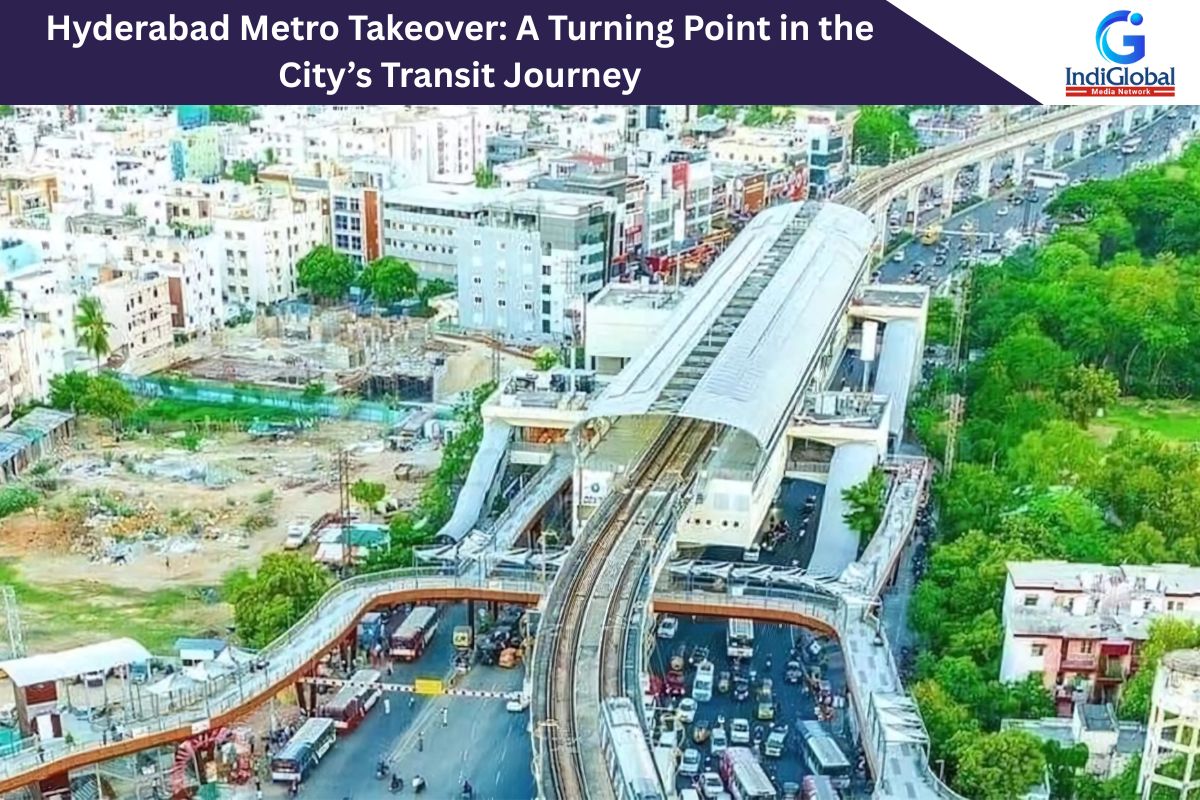
Hyderabad — When Larsen & Toubro (L&T) declared its intent to divest its stake in the Hyderabad Metro and hand over operations to the Telangana government, it set off Wires across political, fiscal, and urban-transport circles. The deal, expected to be sealed by FY26, entails the state absorbing about ₹13,000 crore in debt and paying ₹2,000 crore to L&T for its equity in the metro SPV.
This watershed moment compels us to ask: What does this change mean for Hyderabad’s commuters, for the state’s finances, and even for electoral politics?
The State of Hyderabad Metro: Losses, Debt, and Operational Realities
Since its launch, the Hyderabad Metro has been part promise, part challenge. Under its PPP framework, it faced cost overruns, delays, and rising interest costs.
Some key financial metrics:
- The project is estimated to have been built at a total capital cost of ~ ₹16,375 crore, of which ~₹11,480 crore was debt funding, ~₹3,440 crore equity, and about ₹1,458 crore in viability gap grants.
- L&T Metro has reportedly incurred cumulative losses of about ₹6,000 crore over time.
- In FY 2024–25 alone, the loss (before/after tax) stood at ~ ₹626 crore, up from ₹555 crore in the prior year (a ~13% rise).
- Debt servicing has been a major drain: fare collections and advertisement income cover daily operations, but interest costs push the project into the red.
- Telangana provided soft loans (₹900 crore) to the metro, repayable over 16 years, to partly ease the burden.
Given this backdrop, L&T’s exit isn’t a surprise — and the state’s assumption of debt and operations is a gamble.
Voices from the Ground
|
Persona |
Perspective |
|
Commuter: Priya, software engineer, Kukatpally |
“I use the metro daily — it saves me 40 minutes each way versus road travel. If the government keeps fares stable and speeds up expansions, that will be a huge plus.” |
|
Auto driver: Anand, Secunderabad |
“More metro lines might reduce my passenger load in city centre. But if last-mile connections are bad, people will still use autos.” |
|
Transport planner: Dr. Sameer Rao (Osmania University) |
“The state now has the opportunity to integrate metro, buses, and rail services. But financing, efficiency and non-fare revenue must be managed professionally, else the system will suffer.” |
These voices highlight a central tension: commuters demand affordability and expansion; operators require financial viability.
What the State Takes On
By taking over the metro, Telangana acquires both opportunity and liability:
- Debt burden and fiscal strain — Absorbing ₹13,000 crore of debt will stress the state’s balance sheet. Servicing this will compete with health, education, road works, and welfare expenditures.
- Operational risk — The government inherits a system with structural losses. If ridership doesn’t recover strongly or if cost controls aren’t enforced, recurring losses may necessitate bailouts.
- Opportunity for integration — Under unified control, metro services, bus (TSRTC), and suburban rail (MMTS) can coordinate routes, fares, and last-mile connectivity — something harder in a PPP setup.
- Expansion impetus — With control in hand, the state can expedite Phase II lines, airport connectivity, and feeder systems — decisions that were earlier slowed by stakeholder negotiation.
- Revenue potential — Non-fare revenue (retail, property development around metro stations, advertising) must be aggressively monetized to ease pressure on deficit funding.
- Public accountability — As the metro becomes a state asset, public scrutiny will increase. Service lapses, fare hikes or delays will reflect directly on the government’s stewardship.
Expansion Roadmap: Phase II, Airport Link & JICA Loans
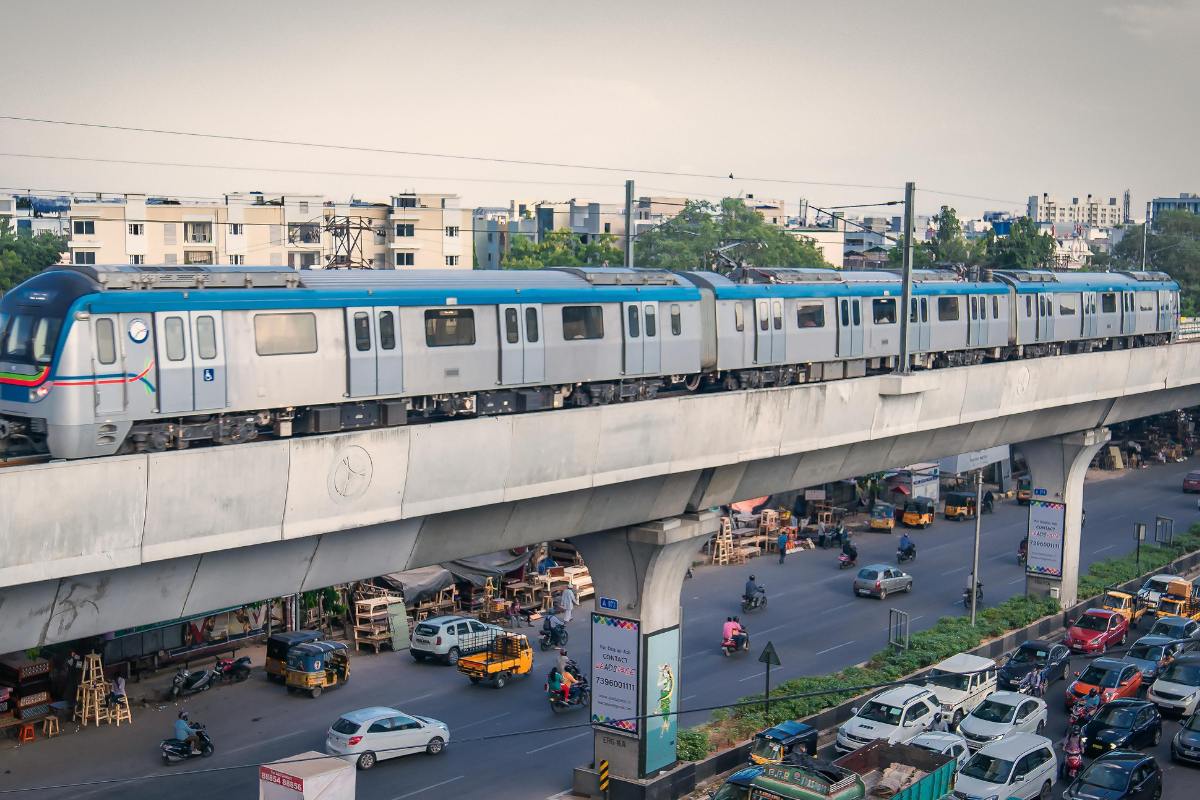
With the Phase I transition underway, the state is already planning ahead. The proposed Phase II network, adding ~163 km in lines (2A + 2B), is estimated at ₹24,269 crore. Funding sources are to be split: 30% state share (~₹7,313 crore), 18% central share (~₹4,230 crore), and ~₹11,693 crore via debt (primarily multilateral loans) such as from JICA.
Also Read: Telangana IAS Shuffle: Surendra Mohan to Agriculture, Raghunandan Rao to Taxes
The government has been exploring JICA support, with nearly 48% of the cost proposed to be financed via overseas loans.
One key metro corridor slated is the Airport Line (Corridor IV) — connecting Nagole to the Rajiv Gandhi International Airport, via LB Nagar, New High Court, etc.
But no private firm has shown willingness to develop Phase II under PPP, citing the losses L&T faced in Phase I.
Comparative Sidebar: Delhi & Bengaluru Models
To frame risks and lessons, here’s how Delhi and Bengaluru manage their metros:
Delhi Metro (DMRC)
- Joint venture: Built as a 50–50 partnership between the Government of India and Delhi’s state government.
- Long-term multilateral funding: DMRC has consistently secured funding from JICA, KfW, ADB, etc. For Phase-4, it recently got ₹4,309.5 crore from JICA.
- Mixed revenue model: Fares, advertising, real estate, naming rights, transit-oriented development help diversify income.
- Subsidy and cost-sharing: Because it is a government-run entity, deficits are periodically covered by budget allocations.
Bengaluru Metro (BMRCL / Namma Metro)
- Hybrid funding model: Central and state contributions plus long-term loans (ADB, JICA, EIB, etc.).
- Non-fare innovations: BMRCL is experimenting with using one coach for cargo in non-peak hours (a scheme used by Delhi Metro) to raise revenue.
- Fare pressure: Bengaluru users pay significantly higher fares compared to Delhi. For instance, a trip up to ~20 km costs ₹70 in Bengaluru vs ₹43 in Delhi.
Lesson for Hyderabad:
A state-run model must combine diversified revenue, efficient operations, transparent subsidy & cost-sharing, and rigorous monitoring to avoid the fate of loss-laden systems. The Delhi model shows that government backing enables long-term sustenance. The Bengaluru experiment underscores that relying solely on fare revenue is untenable.
Political Fault Lines & Risks
- Valuation disputes and accusations of favoritism: BRS (KTR) has accused the Congress government of “targeting L&T” and turning a ₹20,000-crore asset into a ₹15,000-crore liability.
- Fare hike backlash: Public sensitivity to metro fare rise is already manifest — BRS MLAs recently urged government rollback of fare increases initiated in May 2025.
- Election calendar pressures: As civic, municipal or state-level elections loom, metro service performance (delays, frequency, cleanliness) becomes a politically emotive issue.
- Land & real estate stakes: Metro corridors come with land parcels meant for commercial development. Control over these assets is a politically valuable lever.
What Success Looks Like
For the state’s takeover to be judged a success, key metrics must be watched:
- Ridership recovery and growth (especially post-pandemic, with remote-work shifts)
- Operational efficiency — minimal system downtimes, better energy usage, maintenance discipline
- Non-fare revenue maturity — retail leases, naming and advertisement, real estate development
- Debt repayment schedule adherence — refinancing to lower cost, extended maturities, perhaps aid from national/international agencies
- Expansion delivery — new corridors, airport link, better feeder connectivity delivered on or ahead of schedule
- Transparency & public accountability — audited disclosures, rider feedback loops, fare deliberations
IndiGlobal Media’s Take
If the Telangana government leverages its control wisely — pairing professional systems management with prudent financing and urban integration — this takeover could become a turning point in Greater Hyderabad’s transit story. But missteps in financial engineering, fare management, or political interference can quickly turn it into a millstone.