

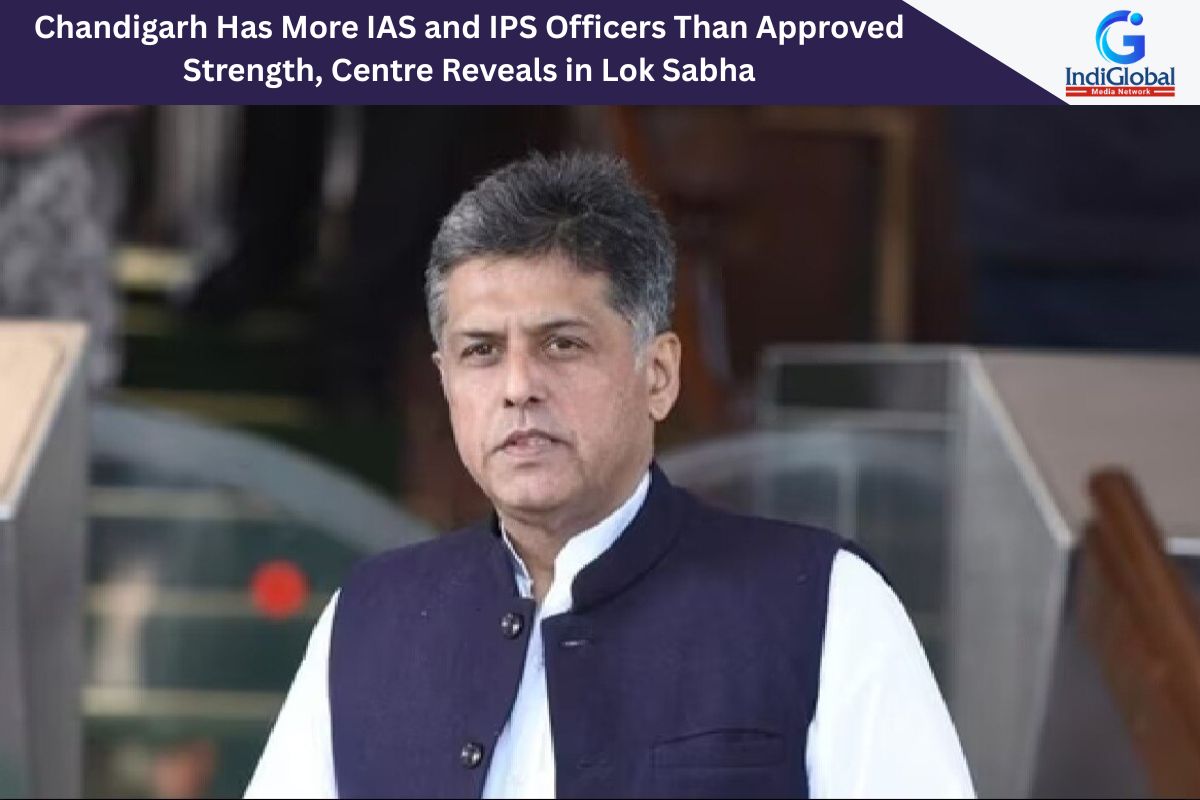
CHANDIGARH: The Central Government has disclosed in the Lok Sabha that Chandigarh is currently functioning with more IAS and IPS officers than its officially sanctioned cadre strength, reigniting discussions over the Union Territory’s administrative structure and staffing pattern.
Responding to a question raised by Chandigarh MP Manish Tewari, Union Minister of State for Home Affairs Nityanand Rai informed Parliament that while the sanctioned strength for Chandigarh stands at 11 IAS officers and 7 IPS officers, the Union Territory currently has 12 IAS and 9 IPS officers in service.
The government further clarified that a significant number of these officers are serving on deputation from neighbouring states. Of the 12 IAS officers, five are on deputation from the Punjab and Haryana cadres, three from Punjab and two from Haryana. Similarly, among the nine IPS officers, two are on deputation, with one each from Punjab and Haryana.
The disclosure has sparked renewed debate over whether Chandigarh’s administrative setup has become disproportionately top-heavy. Raising the issue in Parliament, MP Manish Tewari questioned the rationale behind deploying such a large number of senior officers in a city with a relatively small geographical area, while larger neighbouring districts continue to function with fewer top-ranking officials.
Despite acknowledging the higher-than-sanctioned deployment, the Centre indicated that there is no immediate proposal to review or rationalise the existing administrative structure of the Union Territory. The current arrangement, it said, continues to meet the governance requirements of Chandigarh, which serves the dual role of being a Union Territory as well as the shared capital of Punjab and Haryana.
The figures have once again brought into focus the broader conversation on administrative efficiency, resource allocation, and whether an increase in the number of senior officers necessarily translates into better governance and public service delivery. As the debate unfolds, the government’s disclosure is likely to fuel further discussions on balancing bureaucratic strength with administrative effectiveness.