
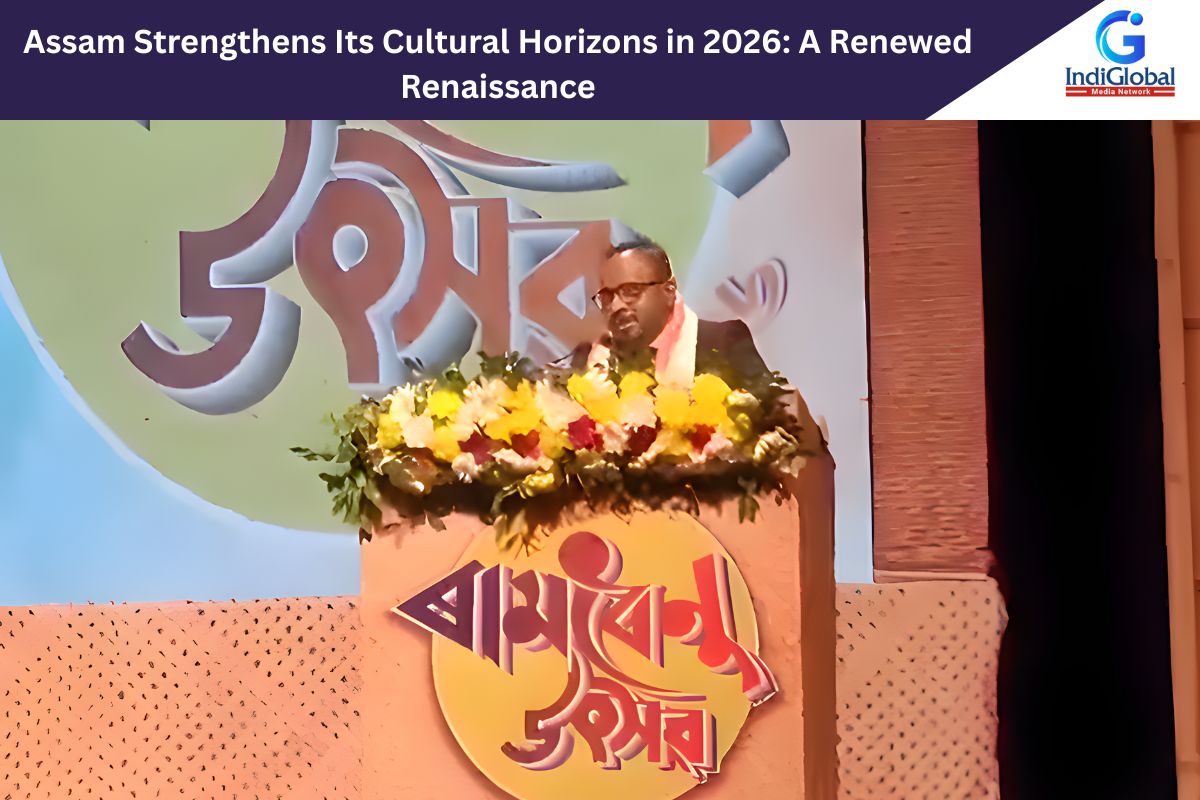
Guwahati : As the sun rises on this New Year, Assam’s cultural landscape stands illuminated by momentum and promise. Dr. B. Kalyan Chakravarthy, IAS Additional Chief Secretary, Cultural Affairs, Government of Assam – delivered an inspiring address that encapsulates the state’s renewed commitment to cultural revival and integration. His words reflect both pride in Assam’s traditions and a vision for taking its heritage to national and global stages.
Celebrating a New Cultural Milestone
Dr. Chakravarthy began by noting the wonderful moment as the Cultural Affairs Department launches into 2026 on a high note. Over the past one to two years, the department has worked to bring Assam “back to the centre of the stage” in the country, a testament to sustained efforts in promoting indigenous culture.
A major highlight of this endeavour has been the inauguration of a 5,000-seat international auditorium, now one of the largest and most modern in the region. Commissioned in late 2025 and inaugurated by Union Home Minister Amit Shah, the venue – named Jyoti-Bishnu Antarjatik Kala Mandir in honour of Assam’s cultural icons Jyotiprasad Agarwala and Bishnu Prasad Rabha – has already become a cultural landmark. This state-of-the-art facility offers world-class infrastructure for performing arts and provides a dignified space that truly respects the artist, according to Dr. Chakravarthy.
Towards a Reinvigorated Cultural Renaissance
Dr. Chakravarthy emphasized that what Assam is experiencing is more than infrastructure growth – it is the reinvigoration of culture itself. He shared that the government’s focus has been on building bridges of artistic dialogue between Assam and the rest of India, celebrating both local traditions and pan-Indian cultural connections.
Kalakshetra Ramdhenu Festival – 2026: A Milestone in Cultural Integration
A centerpiece of this cultural momentum has been the Kalakshetra Ramdhenu Festival-2026, a dynamic cultural extravaganza held at the prestigious Srimanta Sankaradeva Kalakshetra. As reported from the venue, the festival has brought internationally acclaimed classical musicians, dancers, and artistes from across India to Assam, showcasing a rich tapestry of art forms – from Odissi and Bharatanatyam to Hindustani and folk traditions.
Performances included spirited Odissi recitals by Sujata and Pritisha Mohapatra, energetic tabla rhythms by Pandit Bikram Ghosh, evocative sitar pieces by Abhishek Mallick, and stunning Sattriya presentations by Assam’s own cultural custodians. The festival also presented traditional puppet theatre, making for a vibrant, multi-dimensional cultural experience.
In his speech, Dr. Chakravarthy hailed the festival as a milestone in reinforcing how Assam’s music and cultural traditions are intricately woven with the broader fabric of Indian art, bringing artistes together both to celebrate and learn from one another.
Cultural Legacy Meets Contemporary Aspirations
For Assam – a land enriched by traditions like the Bihu dance, Bihu music, and a multitude of tribal arts – such initiatives represent transition and continuity. Over recent years, cultural festivals and record-breaking performances have showcased the enduring vitality of Assamese heritage. For example, Assam’s mega Bihu performances and other folk celebrations have drawn global attention, emphasizing not only local pride but also international curiosity in the state’s cultural expressions.
Today, with modern venues and visionary cultural programming, Assam is positioned not just as a guardian of age-old traditions but as a vibrant cultural hub that invites the world to experience its artistic pulse.
Looking Ahead
Dr. Chakravarthy concluded with optimism, expressing his belief that this tradition of art and culture will continue throughout the year and beyond, reaching greater heights and bringing Assam’s cultural essence to the forefront of national and global recognition.
In an era where global cultural exchange is both enriching and essential, Assam’s commitment to preserving its heritage while embracing diversity serves as a powerful model of cultural stewardship.