


For millions of people living with knee pain, everyday activities such as climbing stairs, walking to the market or getting up from a chair can become increasingly difficult. As the cartilage cushioning the knee joint wears away, movement can become painful, and in advanced cases, knee replacement surgery may be recommended.
Now, research from Stanford University in the United States has offered a promising glimpse of a different future: one in which damaged knee cartilage might be encouraged to grow back.
The discovery has attracted attention because cartilage has very little ability to repair itself naturally. Once significantly damaged, it rarely returns to its original condition.
But before patients begin looking for the new treatment, there is an important distinction. The encouraging results have so far come from experiments involving mice and human cartilage tissue studied in laboratories, not from successful treatment of knee arthritis in living human patients.
What Exactly Have Stanford Scientists Discovered?
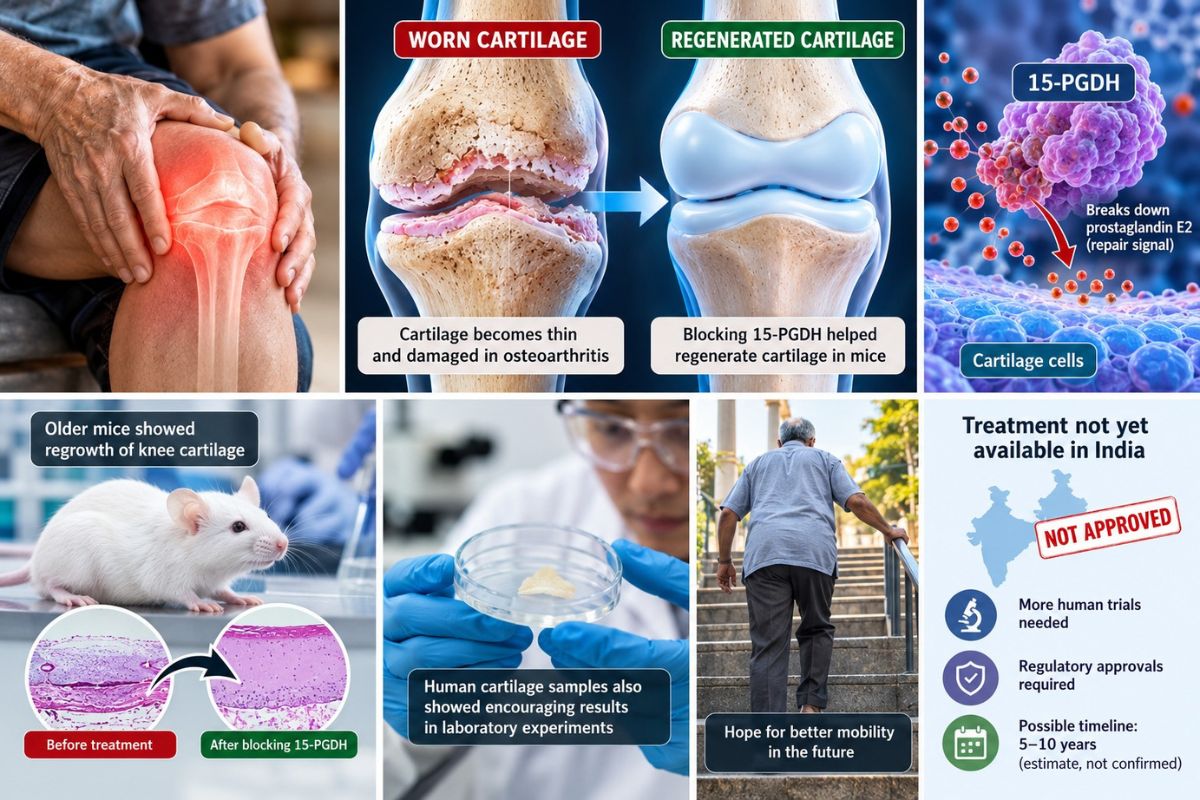
The research focuses on an enzyme called 15-PGDH, which becomes more active as the body ages.
Scientists believe this enzyme can interfere with certain natural processes involved in tissue repair. It breaks down prostaglandin E2, a signalling molecule associated with healing and regeneration.
In experiments involving older mice, researchers blocked the activity of 15-PGDH and observed something remarkable: cartilage that had become thin and worn showed signs of regeneration.
The newly formed tissue also displayed characteristics of the smooth cartilage normally found in healthy joints, rather than simply producing scar-like material.
Researchers additionally examined human cartilage samples in laboratory conditions and observed encouraging responses. These findings suggest that the body may retain some capacity for cartilage repair that could potentially be activated through future medicines.
Why Is This Discovery So Important?
Healthy cartilage acts as a smooth protective cushion between the bones, allowing the knee joint to move with minimal friction.
Over time, cartilage can become thinner and damaged. As osteoarthritis progresses, people may experience pain, swelling, stiffness and difficulty walking.
Existing treatments generally focus on reducing pain, improving movement and managing symptoms. Physiotherapy, weight management, exercise, medicines and, in advanced cases, surgery may be recommended.
However, there is currently no widely established medicine that reliably restores extensively worn knee cartilage to its original healthy condition.
That is why the Stanford findings are attracting scientific interest. Rather than merely reducing discomfort, the experimental approach aims to address the damaged tissue itself.
Could This Mean the End of Knee Replacement Surgery?
Not anytime soon. Although the research is encouraging, it would be premature to suggest that knee replacement surgery will become unnecessary.
The experiments have not yet established whether the treatment can regenerate sufficient cartilage in people with advanced osteoarthritis, restore normal joint function or deliver lasting relief.
Human knees experience complex mechanical stresses that laboratory experiments and animal studies cannot fully reproduce. Researchers must determine whether any regenerated cartilage remains durable under years of walking, climbing stairs and other everyday activities.
Even if the approach proves successful, it may eventually benefit some patients more than others. For people with severe joint deformities or advanced structural damage, surgery could still remain necessary.
Is the Treatment Available in India?
This is perhaps the most important question for Indian patients.
No. The Stanford cartilage regeneration treatment is not currently an approved therapy for routine clinical use in India. The research remains experimental.
Although an inhibitor targeting the same enzyme has undergone early human investigation for a different medical purpose involving muscle function, that does not mean it has been established as a safe or effective treatment for knee osteoarthritis.
Before a cartilage regeneration medicine could be offered to Indian patients, researchers would need to conduct appropriate human clinical trials. Those studies would have to establish its safety, determine suitable doses, demonstrate meaningful improvements in knee health and assess whether the benefits last.
Regulatory approval would then be required before commercial availability. Patients should be cautious about advertisements or clinics claiming that Stanford’s experimental discovery is already available as a proven cartilage regrowth treatment.
When Could Indian Patients Expect Such a Medicine?
There is currently no confirmed launch date, either internationally or in India.
A period of five to ten years is one conceivable development scenario, but it is only a speculative estimate, not an announced research schedule.
Also Read:- Doctor Explains the ‘Silent Fatty Liver’ Epidemic Among Young Indians and How to Reverse It Naturally
The process could take considerably longer, and the treatment may never reach commercial approval if clinical trials do not demonstrate sufficient safety and effectiveness.
The speed of development will depend on future research, human trial results, regulatory decisions and commercial investment. India’s participation in future trials or eventual regulatory approval would also influence when patients here could gain access.
For now, any claim that the medicine will become available in a particular year should be treated cautiously.
What Should People With Knee Arthritis Do Today?
For patients already experiencing knee pain, waiting for an experimental medicine is not a practical treatment strategy.
Doctors generally recommend managing knee osteoarthritis according to its severity, symptoms and impact on daily life.
Appropriate strengthening exercises, physiotherapy, weight management where relevant and carefully selected pain treatments can help many people maintain mobility.
Some patients may benefit from additional medical interventions, while those with advanced disease may require surgical evaluation. People experiencing persistent knee pain, swelling or difficulty walking should consult a qualified orthopaedic specialist rather than attempting unproven cartilage regeneration treatments.
It is also important to remember that not every type of knee pain is caused by cartilage loss.
A Promising Beginning, Not Yet a Cure
The Stanford discovery represents an exciting direction in regenerative medicine.
For decades, one of the major challenges in treating osteoarthritis has been the body’s limited ability to replace damaged joint cartilage. The possibility of restoring that ability through a targeted medicine is scientifically significant.
Yet the distance between a successful experiment in mice and an approved treatment for millions of patients remains substantial.
For people in India living with knee arthritis, the research offers genuine reason for hope, but not a reason to abandon existing medical care.
The real breakthrough will come when scientists can demonstrate that regenerated cartilage is safe, functional and durable in human patients. Until then, Stanford’s findings should be understood as a promising step towards a possible new generation of arthritis treatments, rather than a cure already within reach.