

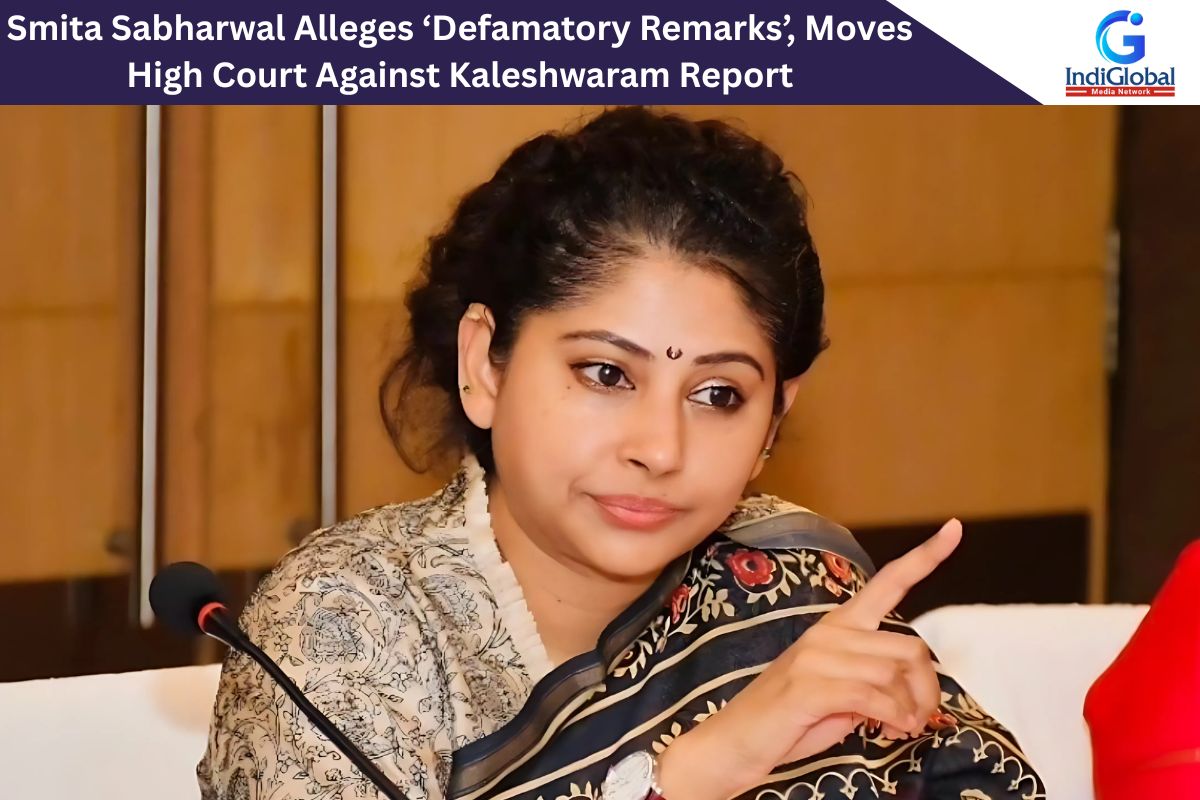
Hyderabad: Senior IAS officer Smita Sabharwal has approached the Telangana High Court, asserting that the Ghose Commission’s report on the Kaleshwaram Lift Irrigation Project made damaging observations against her without granting a fair hearing. She has sought a stay on the report, calling its conclusions “prejudicial and high-handed.”
The commission, headed by Justice Pinaki Chandra Ghose, submitted its report on July 31, 2025, after probing alleged irregularities in the construction of the multi-crore irrigation project. Among its key findings, the panel recommended action against Sabharwal for her role as Secretary and Additional Secretary in the Chief Minister’s Office (CMO) during the BRS regime. It alleged that she granted approvals for works related to the Medigadda, Annaram and Sundilla barrages without placing the matters before the state cabinet, a move the commission described as a violation of established business rules.
The report also cited her site inspections, monitoring of progress, and involvement in file clearances as evidence of active participation in decision-making.
However, Sabharwal, often referred to as the “People’s Officer” for her public-oriented administrative work, has strongly refuted these conclusions. In her writ petition, she stated that she had no independent decision-making authority in the project and was only performing her routine duties as an officer attached to the CMO. She further argued that the commission never offered her an opportunity to present her side before recording adverse findings, which she claims is a violation of Sections 8-B and 8-C of the Commissions of Inquiry Act, 1952. These provisions specifically mandate that individuals likely to face adverse remarks must be given a chance to be heard.
Calling the report’s remarks “defamatory” and “unjustified,” Sabharwal maintained that they tarnish her professional reputation and career. Her petition underscores the larger issue of ensuring fairness and accountability in commissions of inquiry, which often deal with politically sensitive projects.
Also Read:- Union IT Minister Ashwini Vaishnaw Switches to Zoho: What It Means for Indians
The Kaleshwaram Lift Irrigation Project, once projected as the world’s largest multi-stage lift irrigation scheme, has been under intense scrutiny in recent years. Conceived to provide water for irrigation, drinking and industrial purposes across Telangana, the project has faced criticism over ballooning costs, engineering lapses and questions of financial prudence. The collapse of the Medigadda barrage piers in 2023 only added to the controversy, prompting successive governments to investigate possible mismanagement and corruption.
The Ghose Commission was tasked with probing these concerns and fixing accountability. While the report has already sparked political debate, Sabharwal’s legal challenge has shifted attention to whether the commission followed due process while naming individual officers. Legal experts say the High Court’s handling of the case will be watched closely, as it could set precedents on how inquiry commissions balance fact-finding with fairness to individuals.
For now, the High Court is expected to hear Sabharwal’s petition in the coming days. The outcome may not only decide her personal battle but also influence how the narrative on one of Telangana’s most ambitious yet controversial projects unfolds.
Kaleshwaram at a Glance
- What it is:
The Kaleshwaram Lift Irrigation Project (KLIP) was designed as the world’s largest multi-stage lift irrigation scheme.
- Objective:
To draw water from the Godavari River and provide irrigation to over 37 lakh acres, along with drinking and industrial water supply across Telangana.
- Estimated Cost:
Initially pegged at around ₹40,000 crore, the project’s expenditure ballooned to over ₹1 lakh crore.
- Key Structures:
Major barrages include Medigadda, Annaram and Sundilla, forming the backbone of water storage and pumping.
- Controversies:
- Engineering Issues: Structural failures, including the collapse of Medigadda barrage piers in 2023.
- Cost Escalation: Sharp increase in expenditure raised concerns of financial imprudence.
- Political Debate: Successive governments accused each other of corruption and mismanagement.
- Engineering Issues: Structural failures, including the collapse of Medigadda barrage piers in 2023.
- Current Status:
Under review by state and central agencies, with repair, accountability and long-term sustainability under question.