

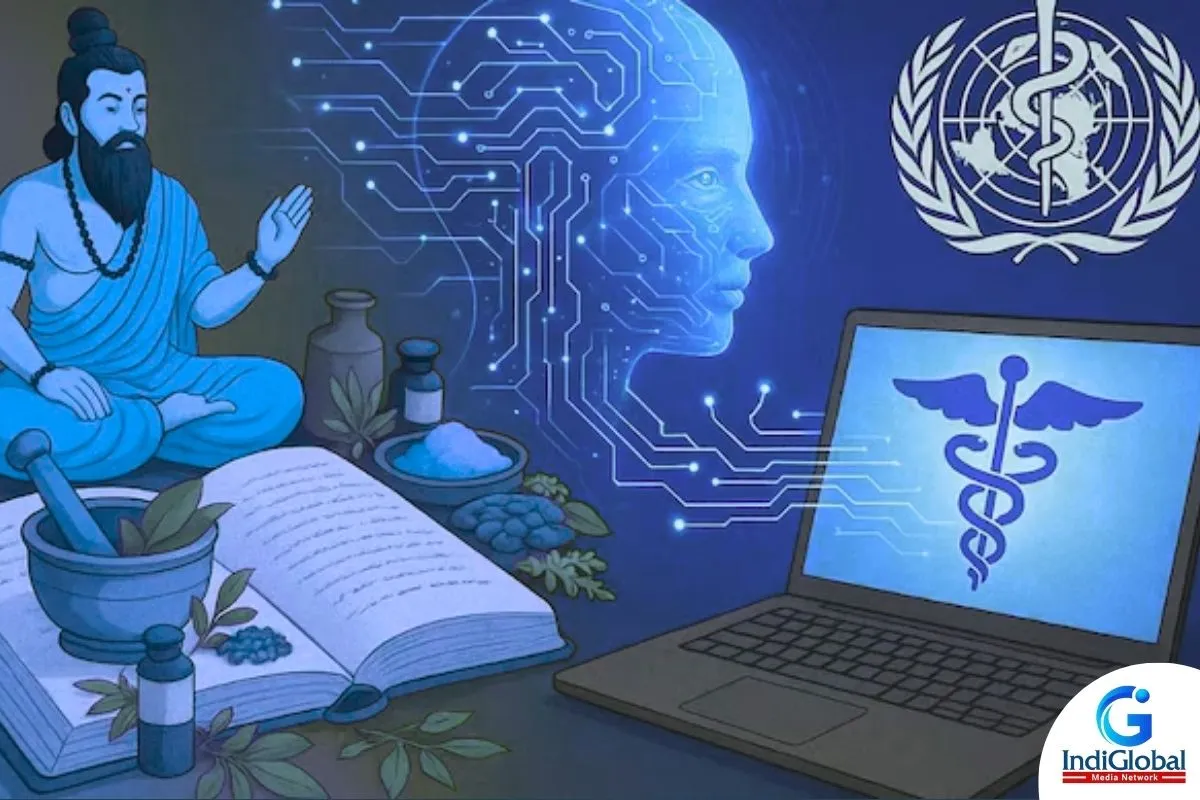
IndiGlobal Media: In a compelling convergence of ancient wisdom and cutting-edge technology, India has achieved a global first: the World Health Organization (WHO) has featured the use of Artificial Intelligence (AI) in AYUSH systems—Ayurveda, Yoga & Naturopathy, Unani, Siddha, Sowa Rigpa, and Homeopathy—in its latest global brief on traditional medicine.
This inclusion celebrates India’s bold vision to integrate AI with traditional medicine, positioning the country at the forefront of “tech-powered healthcare” on a global stage. As the Ministry of AYUSH proudly stated: “A proud moment as AI in AYUSH systems is featured in WHO’s global report, recognized for its pioneering use of Artificial Intelligence (AI)”.
Also Read:- Easing Education Funding Burden with AI-Powered Financial Solutions
Technological Innovations in Traditional Medicine
- AI‑powered diagnostic tools: Pulse, tongue, Prakriti (constitutional) and voice analyses are now being conducted using advanced sensor analytics and machine learning. These systems enhance accuracy, reduce practitioner bias, and extend diagnostic capabilities to rural areas.
- Ayurgenomics: A cutting-edge intersection of Ayurveda and genomics, bolstered by AI-driven modeling, is enabling personalized healthcare based on individual biological constitution.
Digital Infrastructure: The Foundation of Progress
At the heart of this transformation lies the Ayush Grid, launched in 2018, which supports AI-enabled initiatives like:
- SAHI (Smart AI‑based Health Initiatives)
- NAMASTE (National AYUSH Morbidity & Standardized Terminologies)—also called NAMAST
- Ayush Research Portal
These platforms facilitate systematic digitization, validation, and global integration of traditional knowledge.
The Traditional Knowledge Digital Library (TKDL), now enhanced with AI, serves as a protective repository against biopiracy while transforming ancient manuscripts into globally accessible, machine‑readable data.
Also Read:- PM Modi Calls for Collective Action Against Obesity, Appoints Eminent Leaders to Lead the Fight
A Model for Global Health Innovation
WHO’s brief highlights how India’s AI‑augmented AYUSH systems set the stage for personalized care, new drug discovery, and biodiversity research. These innovations are viewed as transformative not just nationally but also as potential models for global adoption.
This recognition builds on prior cooperation: earlier this year, India’s Ministry of AYUSH signed an MoU with WHO to incorporate traditional medicine into the International Classification of Health Interventions (ICHI), aiming to standardize global understanding and usage.
Why This Matters: India’s Growing Global Leadership
- Tech‑powered soft power: India is consolidating its reputation in global health by blending AI and indigenous medicine.
- Ancient wisdom meets modern evidence: Through AI-enhanced validation, traditional therapies now boast reproducible, scientifically grounded frameworks suited for clinical research.
- Democratizing healthcare: Remote diagnostics and AI‑driven personalization promise more equitable access, especially in rural and under‑served regions.
What Comes Next
India’s path forward includes expanding AI-powered AYUSH platforms, integrating them with mainstream healthcare systems, and championing international collaboration under WHO’s leadership. The digitization and analytic rigor promised by AI could soon unlock new herbal discoveries, drive evidence-based practice, and elevate global policy standards for traditional medicine.
By earning a prominent place in WHO’s global report, India sends a clear signal: the union of AI and tradition isn’t just a novelty—it’s a blueprint for the future of integrative healthcare. This milestone solidifies India’s role as a global innovator at the intersection of heritage and high-tech.