

IndiGlobal Bureau
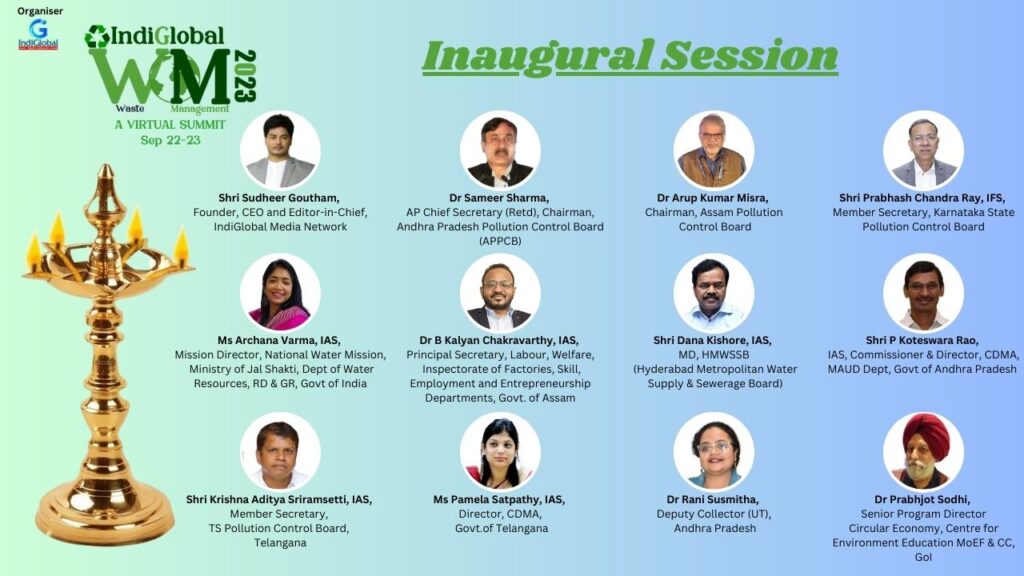
“The learnings were many from the two-day IndiGlobal Waste Management Summit that concluded on September 23, 2023. Also, I interacted with several stake holders and hope to collaborate with quite a few of them in the coming days, said Dr Rani Susmitha who is to be the deputy collector in one of the districts in Andhra Pradesh. Likewise, several panelists and viewers who were part of the virtual summit echoed similar sentiments.
 The two-day summit witnessed a wide spectrum of topics including Challenges, Best practices and Innovations in Waste Management, Circular economy and its growing relevance, Municipal Solid waste Management, Urban Sanitation and Industrial Waste, Biomedical & Hospital Waste, EPR its implementation challenges, Corporate Social Responsibility in waste management Waste to Wealth, Challenges in e-Waste Management and more.
Call for water tariff regulatory authority
In what can be termed as one of the most intriguing and interactive session in the inaugural was the role of government policies and regulations in wastewater management. Dana Kishore, IAS, MD, Hyderabad Metropolitan Water Supply and Sewerage Board) HMWSSB called for the need to establish a water tariff regulatory authority to bring in some sort of semblance and proper utilization of water. He further added, “
Archana Varma, MD, National Water Mission drew the attention to the need to conserve water. To drive home her point she said that in the past cities were built around water but colonization resulted in man versus nature.
Govt handholding sought for EPR success
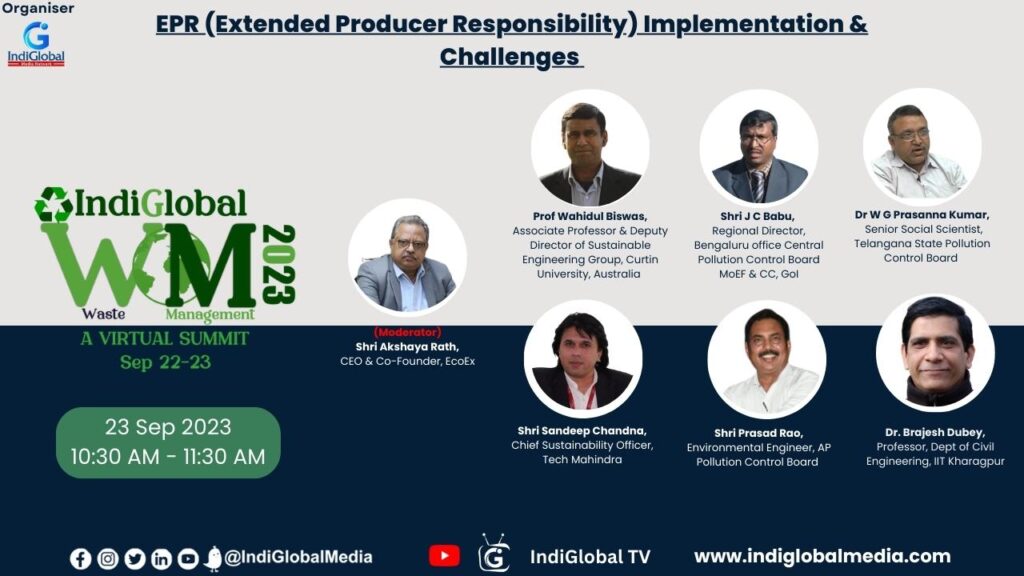 For the successful implementation of Extended Producer Responsibility (EPR) there was a consensus that the Government was doing a good job in framing rules but there is a need to handhold smaller companies coupled with awareness. The biggest challenge opined the speaker was providing knowledge to recyclers on EPR rules. In spite of a centralized EPR portal, data is not being filled to desired level and authorized recyclers have no understanding of EPR. There is need for training,” said Prasad Rao, Environmental Engineer, AP Pollution Control Board. “We need enumeration before regulation for implementation of EPR,” opined Dr W G Prasanna Kumar, Senior Social Scientist, Telangana State Pollution Control Board. The session was moderated by Akshaya Rath, CEO & founder, EcoEx.
ESG is not mere jargon
“ESG is not just jargon but action and is also about attracting investment.” – A Vani Prasad, DG, Environment Protection Training and Research Institute (EPTRI). Sustainable Waste management involves efficient use of resources. Companies can be evaluated on their resource efficiency in waste collection, transportation, and disposal processes.
It was felt that companies have begun to prioritize their operations and are better positioned to address environmental challenges, safeguard communities and ensure long-term profitability and resilience.
Decentralize Waste Management
 If there was one aspect which all agreed, it was decentralization of waste management. The effective management of waste can happen only if waste is segregated at source and recycled locally. “Transporting waste to landfill sites should be the last option.” -Anita Aggarwal, Faculty & Head, EMD, ESCI
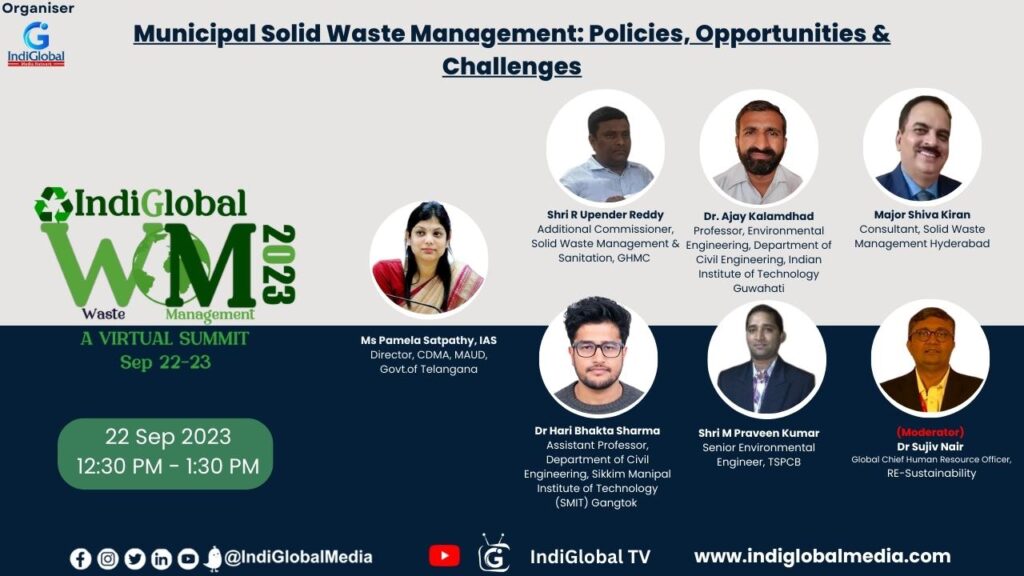
“Smaller communities should be empowered with decentralization waste management system,” said Major Shiv Kiran, Consultant, Solid waste Management, Hyderabad.
Stressing on the theme, Vijay Sai Meka, Secretary General, National Real Estate Development Council, Telangana Chapter said, “If we can convince RWAs to convert wet waste at source and convert to manure, a lot of problems will be solved.”
Dr Ajay Kalamdhad, Professor, Environmental Engineering, Dept of Civil engineering, IIT-Guwahati said, “Segregation followed by composting is the way out for successful waste management.”
Way to go with biomedical waste
Everyone speaks about solid waste management but hardly on biomedical waste. A neglected area in the overall waste generation. With the growing number of hospitals and ever growing biomedical waste, the hazards are increasing. Speaking in the panel- ‘Biomedical Waste and Hospital Waste,’ B Kishore Reddy, CEO & MD, Amor Hospitals, Hyderabad said, “Collection and segregation is done by housekeeping staff and nursing staff but there is attrition and need for awareness.”
In corporate hospitals too it is found that there isn’t enough store rooms for biomedical waste which needs to be separated in four bins with the colours- yellow, red, blue and white. Big hospitals are segregating yellow, red, blue and white bags but are stored in small rooms. It is an issue," said Namilikonda Raveendhar, Chief Scientist (R & D), EPTRI (Environment Protection Training and Research Institute), and Hyderabad.
“India should look at local ecology for rapid implementation of bio-medical waste,” said Dr Subodh Kandamuthan, Director, PGDM (Hospital Management), ASCI, Hyderabad. Explaining the state of affairs, Prof. GVRK Acharyulu, Programme Advisor, MBA Healthcare & Hospital Management School of Management Studies, University of Hyderabad said, “According to CPCB statistics biomedical waste generation is 780 tonnes per day. The need is to invest new technologies to manage biomedical waste.”
CSR should extend to Tier-2 and Tier-3 municipalities
When it comes to Corporate Social Responsibility, companies are keen in spending in waste management but according to Pamela Satpathy, IAS, Director, CDMA, Municipal Administration and Urban Development Department, Govt.of Telangana- There is a need to handhold smaller Tier-2 and Tier-3 municipalities. Speaking in the panel on CSR in Waste Management, Pamela Satpathy said that the first requirement is an analysis of respective ULB for rolling out CSR and secondly to extend to smaller towns and cities.
Stating that India is the only country mandating companies to spend 2% of profits for CSR, Dr Prabhjot Sodhi, Senior Program Director, Circular Economy, Centre for Environment Education, MoEF & CC, GoI further added that money is not the only convergence. Transparency, Traceability and institutional building are to be included.”
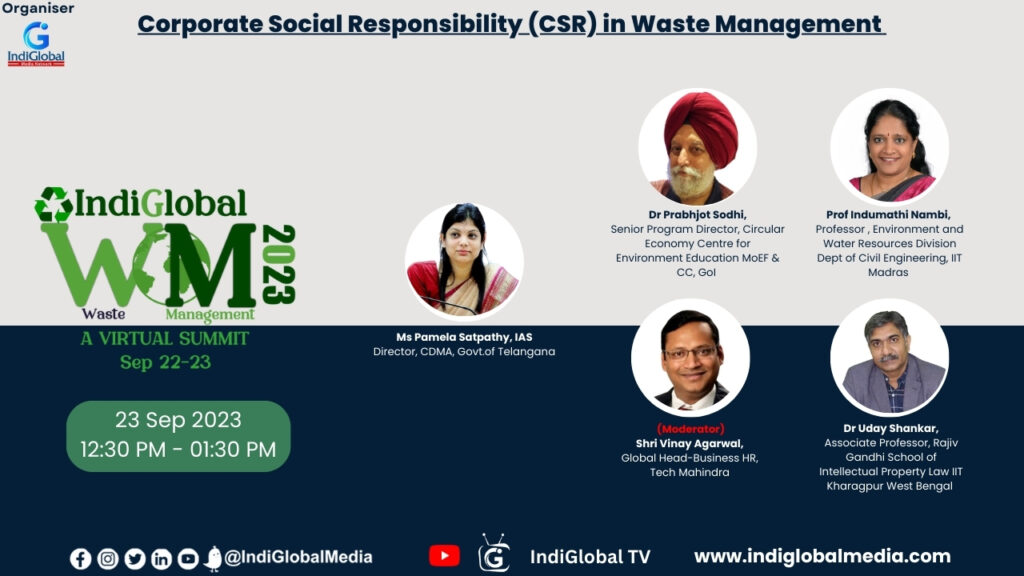 Speaking about research and solutions, Prof Indumathi Nambi, Professor, Environment and Water Resources Division, Dept of Civil Engineering, IIT Madras said that there are solutions but are not moving from lab to market. Need corporate to fund but Dr Uday Shankar, Associate Professor, Rajiv Gandhi School of Intellectual Property Law, IIT Kharagpur, West Bengal had a diametrically opposite view. He said, “How and where to invest in CSR should be left to the corporate to decide.” The session was moderated by Vinay Agarwal, Global Head-Business HR, Tech Mahindra. In his concluding remarks, he said that along with CSR Individual Social Responsibility also will play a major role in waste management.
No benchmark for sound management of e-waste
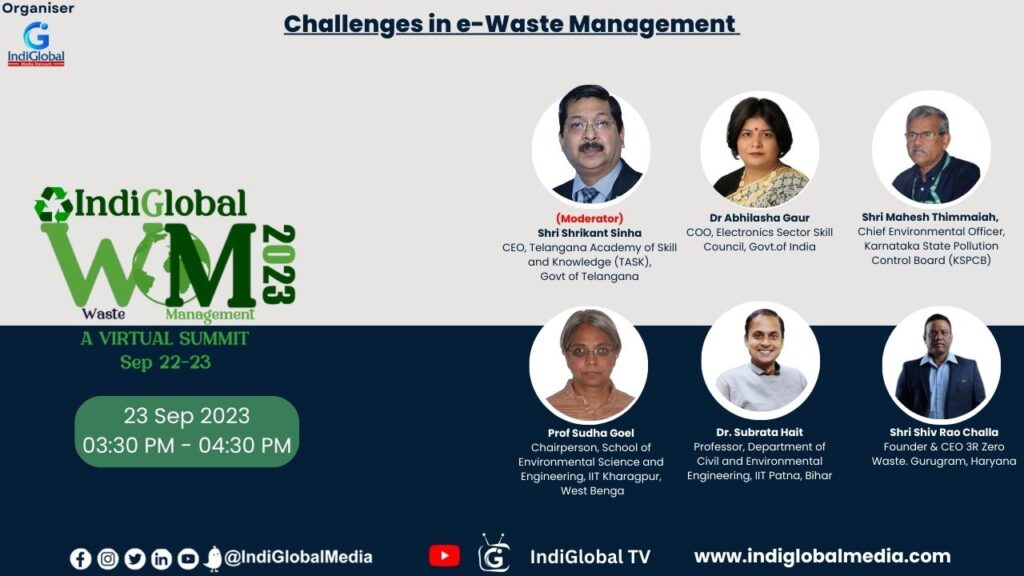 The management of e-waste is still in a nascent stage and there are a host of issues pertaining to the collection and recycling of e-waste. “We do not have benchmarks for a sound management of e-waste as opposed to solid waste management,” said Dr. Subrata Hait, Professor, Department of Civil and Environmental Engineering, IIT Patna, Bihar.
The foremost challenge is the lack of knowledge among the population. Deblina Dutta, Assistant Professor, Department of Environmental Science and Engineering, SRM University, Andhra Pradesh said, “The first challenge in e-waste management is the lack of awareness on the issues pertaining to e-waste.”
Coupled with the lack of awareness there is no proper data. Mahesh Thimmaiah, Chief Environmental Officer, Karnataka State Pollution Control Board KSPCB) said, “Lack of reporting by bulk generators to the regulator including by government departments is a major problem.”
“Data centres can be built in circular economy model,” said Shiv Rao Challa, Founder & CEO, 3R Zero Waste. Gurugram, Haryana. Moderating the session, Shrikant Sinha, CEO, Telangana Academy of Skill and Knowledge (TASK), Govt of Telangana said that in the past, the idea was to reuse, refurbish and only recycle if it is completely impossible to use. He also drew the attention towards the attitude of people towards e-waste. He said, “We expect money while disposing e-waste and many a time also keep defunct electronic items for home for years on end without giving it away.”
Technology has a huge role in waste to wealth
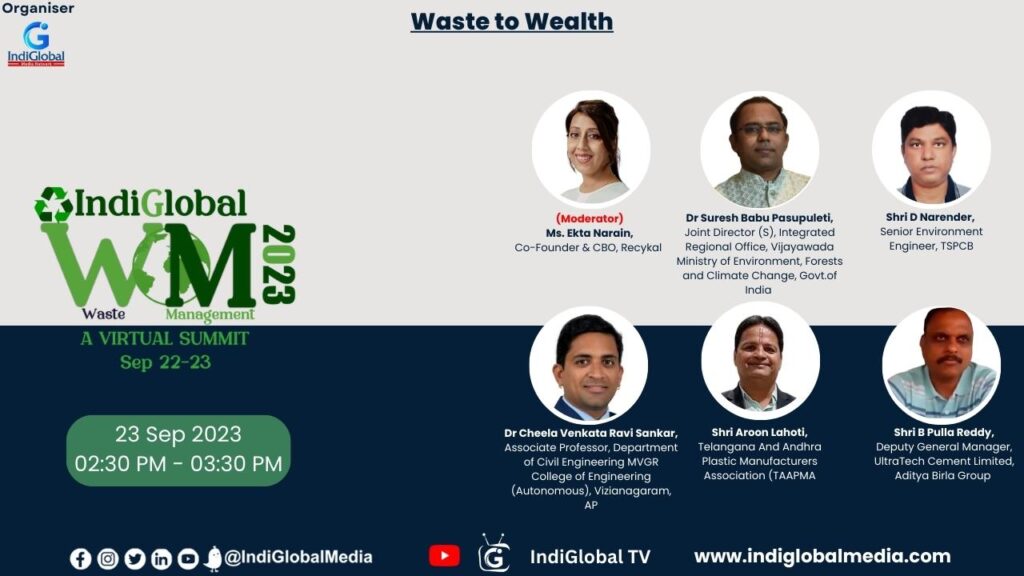 Technology has a humungous role in waste to wealth segment and the optimization of resources by augmenting technology can go a long way in waste to wealth. The proper utilization of municipal solid waste could be helpful but only 28 % of the municipal solid waste is used and to maximize the usage is the need,” said B Pulla Reddy, Deputy General Manager, UltraTech Cement Limited, Aditya Birla Group.
India has not managed to scale up recycling of waste to the desired extent. “India started composting in 1955 and now ULBs are shaping their priorities for waste management now.” – “Mechanical recycling and reshaping into new products has limitations.” Aroon Lahoti, General Secretary, Telangana And Andhra Plastic Manufacturers Association (TAAPMA).
Technology can play a major role and municipal waste can be converted into energy in form of gaseous or electricity but cost effective technologies are needed said Dr Suresh Babu Pasupuleti, Joint Director (S), Integrated Regional Office, Vijayawada Ministry of Environment, Forests and Climate Change, Govt.of India. “Depolymerization and new technologies can be a game changing solution,” said Aroon Lahoti. The session was moderated by Ekta Narain, Co-Founder & CBO, Recykal.
In the 21st century, waste is being seen as a resource
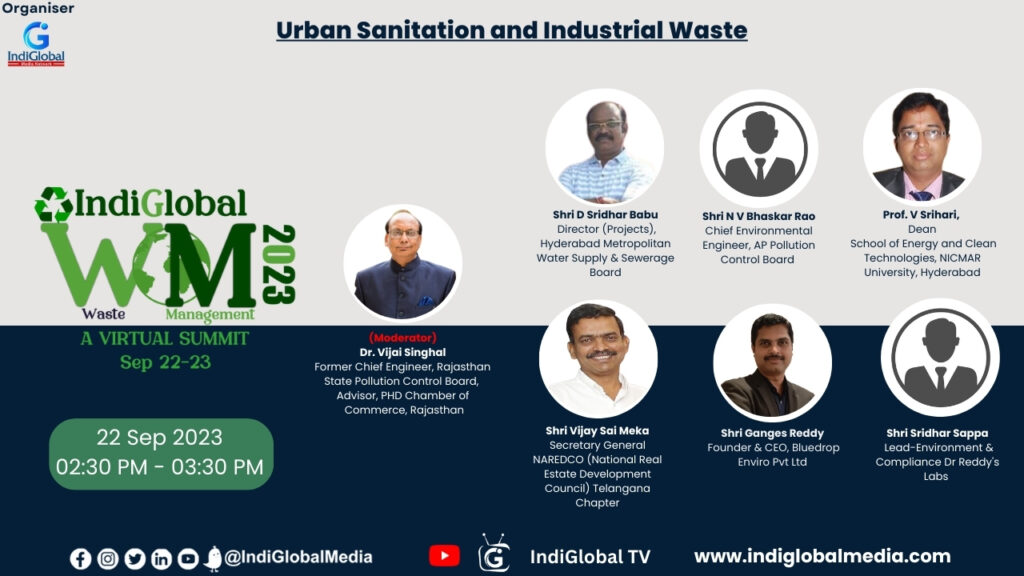 While there is a concerted effort by the respective state governments, the logical end to waste management which should result in not polluting the environment is far from satisfactory. However, there is change albeit slow but for sure. In the panel discussion on Urban Sanitization and Industrial Waste, Prof V Srihari, Dean, School of Energy & Clean technologies, NICMAR University, Hyderabad said that in the 21st century, waste is being seen as a resource.
Speaking about the initiatives of the Andhra Pradesh, N V Bhaskar Rao, Chief Environmental Engineer, AP Pollution Control Board said, “Two waste to energy plants in Vishakhapatnam and Guntur generate 15 MW power.”
Vijay Sai Meka, Secretary General, National Real Estate Development Council, Telangana Chapter said, “If we can convince RWAs to convert wet waste at source and convert to manure, a lot of problems will be solved.”
Speaking in the concluding session, Sudheer Goutham, CEO & Founder, IndiGlobal Media Network said, “The two-day Waste Management Summit which was in virtual mode would be followed by a physical summit in the coming months. He thanked all industry, government departments at the centre as well as the state governments and the academia for participating in the summit which was timely, intriguing and result oriented.”